

Duc Duc Tomb Overview
Duc Duc Tomb is a peaceful and historically significant royal mausoleum in Hue, serving as the resting place of Emperor Duc Duc, a tragic Nguyen emperor who ruled for only three days in 1883. Unlike the grand and elaborate tombs of other Nguyen kings, the tomb features a simple architectural style surrounded by tranquil green landscapes. This sacred site also houses the burial places of Emperor Thanh Thai and Emperor Duy Tan, two patriotic emperors remembered for their love of the nation.
Located in An Cuu Ward, Hue City, Duc Duc Tomb offers visitors a quiet atmosphere and a meaningful glimpse into the rise and fall of the Nguyen Dynasty. The site reflects an important chapter in Vietnam’s royal history, marked by political struggles and changing fortunes within the imperial court. Visiting Duc Duc Tomb is a unique experience for travelers seeking cultural insights and a deeper understanding of Hue’s imperial heritage.
Duc Duc Royal Tomb Location
Duc Duc Tomb is located in An Cuu Ward, Hue City, central Vietnam, approximately 3 kilometers southwest of Hue Imperial City. Thanks to its convenient location, visitors can easily reach the tomb by Hue private car, taxi, motorbike, or bicycle within around 10–15 minutes from the city center.
The tomb is often included in Hue historical tours, alongside famous attractions such as the Imperial City, Tu Duc Tomb, and Khai Dinh Tomb. Due to its peaceful atmosphere and historical value, Duc Duc Tomb is highly recommended for travelers seeking a deeper understanding of Hue’s royal history beyond the more popular landmarks.
Biography of Emperor Duc Duc
Emperor Duc Duc, whose birth name was Nguyen Phuc Ung Ai and later changed to Nguyen Phuc Ung Chan, was the fifth emperor of the Nguyen Dynasty in Vietnam. Born on February 23, 1852, he ascended the throne on July 19, 1883, but his reign lasted only three days, making it the shortest reign among the 13 emperors of the Nguyen Dynasty.
His brief rule took place during a turbulent period in Vietnamese history, marked by political instability and internal struggles within the royal court.
After his passing on October 6, 1883, Emperor Duc Duc was posthumously honored by Emperor Thanh Thai with the temple name Cung Tong and the title Hue Emperor. The name “Duc Duc” became associated with him because he lived at Duc Duc Residence (Duc Duc Duong) during his lifetime.
Although his reign was tragically short, Emperor Duc Duc remains an important historical figure whose life reflects the political changes and dramatic events of the late Nguyen Dynasty.
Duc Duc Tomb History
Emperor Duc Duc briefly ascended the Nguyen throne in 1883. However, his reign lasted only three days before he was dethroned due to political conflicts within the royal court and imprisoned at the Thai Y Vien (Royal Medical Institute). Tragically, he later passed away from starvation and harsh imprisonment conditions at the Thua Thien prison after reportedly being denied food and water for several days. Initially, Emperor Duc Duc was temporarily buried at Phuoc Qua Hill, near Tuong Quang Pagoda in Hue.
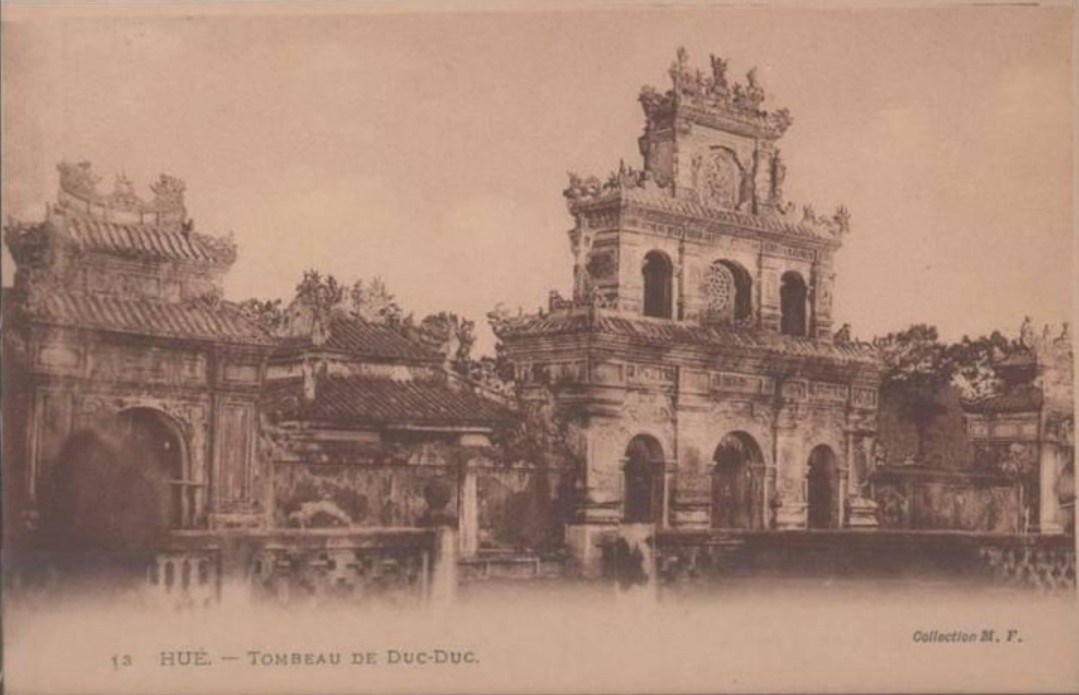
In 1889, his son Nguyen Phuc Buu Lan became emperor under the reign title Emperor Thanh Thai. To honor his late father with filial devotion, Emperor Thanh Thai ordered the construction of a royal tomb known as An Lang (An Mausoleum), located approximately 200 meters from Tuong Quang Pagoda. The tomb was built as a peaceful resting place for Emperor Duc Duc and later became an important historical and spiritual site of the Nguyen Dynasty.
In 1891, Emperor Thanh Thai continued to commemorate his father by building Tan Mieu (Tan Temple) in Thuan Cat Ward, situated to the right of the Imperial Citadel. The temple was dedicated to the worship of Emperor Duc Duc and reflected the emperor’s deep respect and remembrance for his father despite the tragic circumstances surrounding his reign.
Later, in August 1899, Emperor Thanh Thai commissioned the construction of Long An Palace near Emperor Duc Duc’s tomb to serve as an ancestral worship site. Following the tragic death of Emperor Duy Tan in Africa at the end of 1945, a memorial ceremony was held at the palace, and Emperor Duy Tan was also worshipped there, strengthening the historical significance of the complex.
When Emperor Thanh Thai passed away in 1954, his remains were returned to Hue and buried within the grounds of An Lang, while Long An Palace became his place of worship. In 1987, the remains of Emperor Duy Tan were repatriated to Vietnam and laid to rest beside Emperor Thanh Thai’s tomb. Since then, the Duc Duc Tomb complex has stood not only as the resting place of three Nguyen emperors but also as a powerful symbol of Vietnam’s royal history, cultural heritage, and the resilience of a dynasty shaped by political upheaval.
Minh Mang Tomb Secrets – The Hidden Burial Chamber and the Mysterious Tunnel Beneath
Architecture of Duc Duc Tomb
Architectural Style
Duc Duc Tomb features a simple and peaceful architectural style, different from the grand and luxurious tombs of many Nguyen emperors in Hue. The tomb area covers around 3,455 square meters and reflects a quiet beauty that matches the tragic story of Emperor Duc Duc. At the entrance, visitors can see a brick arch gate, while the main tomb area has two roof-like layers designed in a traditional style.
Behind the ceremonial courtyard, the pathways are paved with bricks on both sides instead of being decorated with stone statues like many other royal tombs. This simple design gives Duc Duc Tomb a calm and respectful atmosphere. The peaceful setting also helps visitors feel the historical importance of the site.
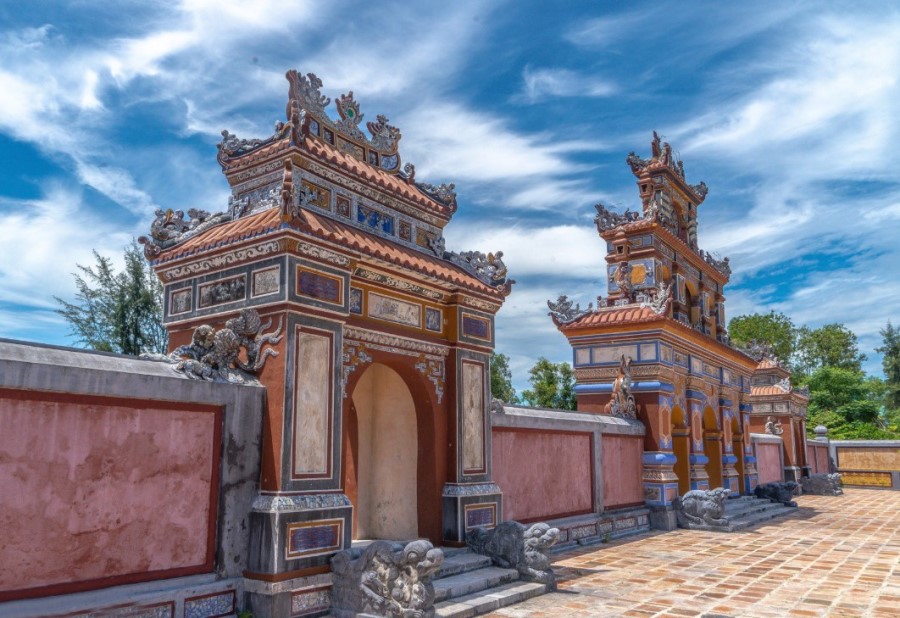
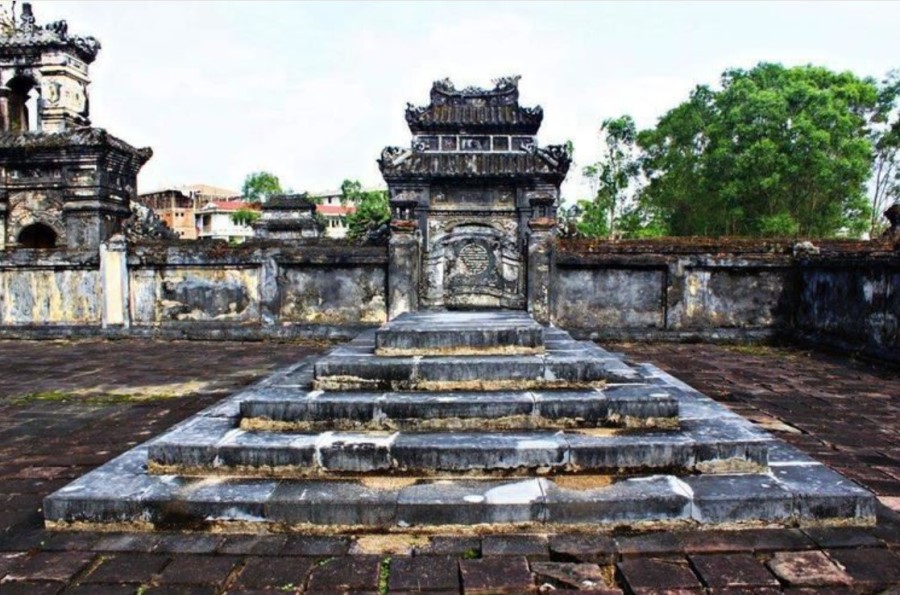
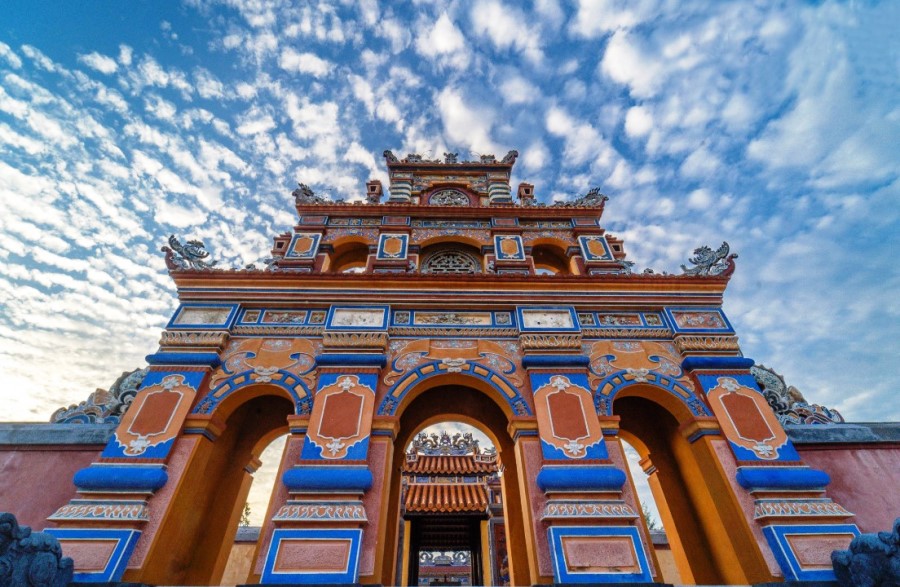
Further inside, visitors will find a large three-level Tam Quan Gate, which is often compared to the Truong An Gate of the Imperial City because of its impressive appearance. In the center of the complex lie the tombs of Emperor Duc Duc and Empress Tu Minh, protected by three strong surrounding walls. The roof decorations are carefully made with beautiful yellow glazed tiles, adding a touch of royal elegance to the tomb.
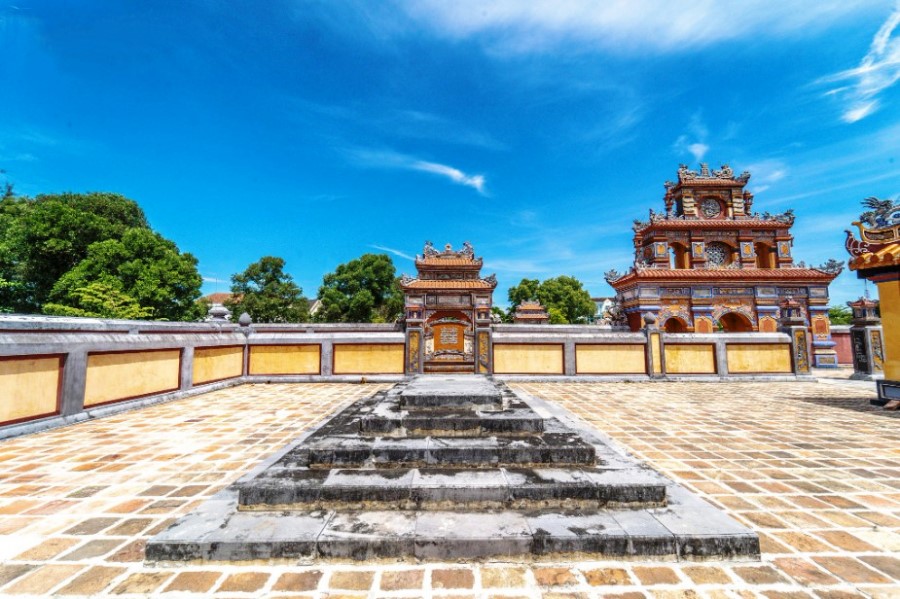
Inside the worship area, visitors can easily notice the stone altar placed at the center. On both sides of the temple are the symmetrical tombs of Emperor Duc Duc and Empress Tu Minh, designed in balance and harmony. In front of the tombs are raised carvings of the Chinese characters for “Longevity” and “Double Happiness,” while outside the burial area stand two brick pillars decorated with lotus flower symbols, representing purity and peace.
The Worship Area in Duc Duc Tomb
Located about 50 meters from the burial area, the worship complex of Duc Duc Tomb covers an area of more than 6,245 square meters and is enclosed by surrounding walls on all four sides. Each side features a gate leading outside, creating a harmonious layout and convenient connection between different sections of the tomb complex.
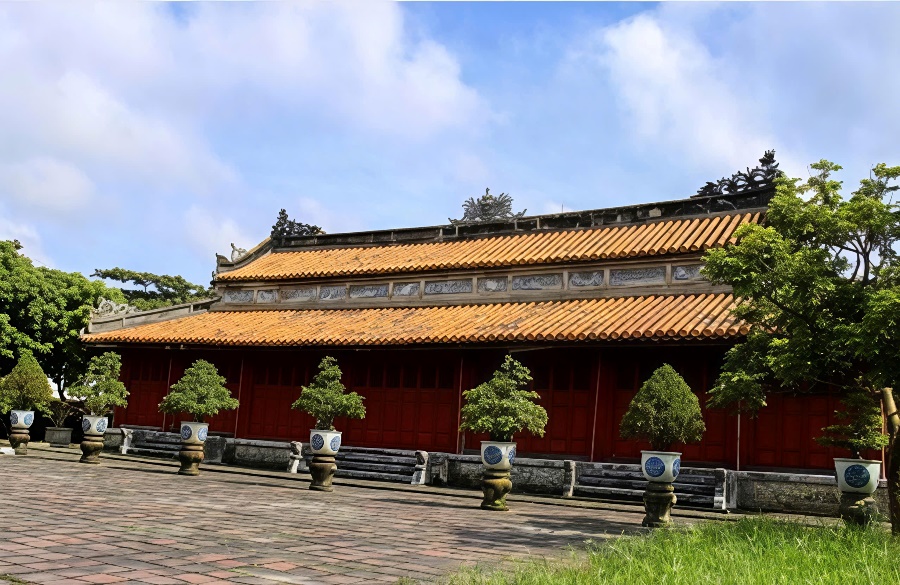
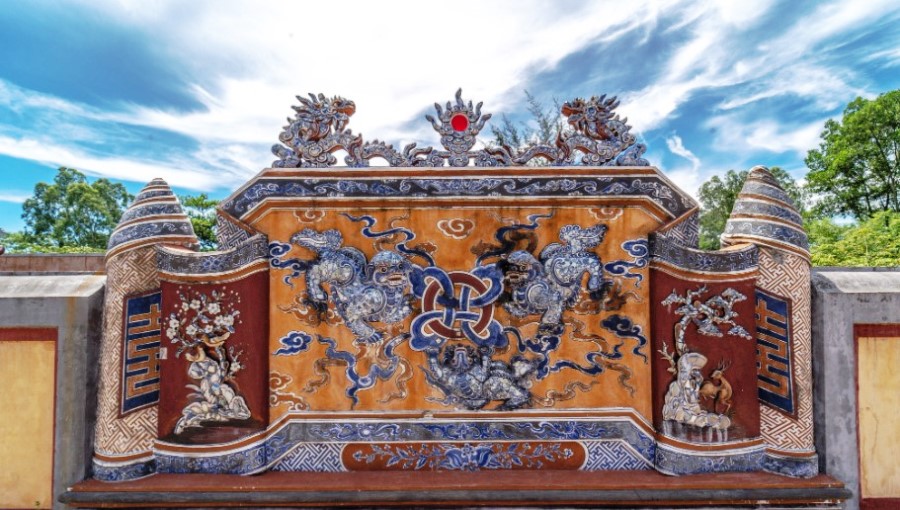
The main gate of the worship area is designed in the traditional three-entrance (Tam Quan) architectural style, distinguished by its four cement roof tiers and intricately decorated panels adorning the gate structure. Meanwhile, the side and rear gates are built in elegant arched designs, adding a graceful touch to the overall architecture.
Just beyond the main entrance stands a decorative screen wall, followed by the ceremonial courtyard paved with traditional Bat Trang bricks, reflecting the distinctive elegance of Nguyen Dynasty royal architecture.
Long An Palace – The Centerpiece of the Worship Area
Situated at the heart of the worship complex, Long An Palace is the most important structure within the Tam Dien area. The building was constructed in the traditional “trung thiem diep oc” architectural style (double-roofed, overlapping structures), consisting of three compartments and two double wings, showcasing the sophistication and grandeur of imperial Nguyen architecture.
Inside the palace are three main ancestral altars:
- The central altar is dedicated to Emperor Duc Duc and Empress Tu Minh Hue.
- The left altar honors Emperor Thanh Thai.
- The right altar is dedicated to Emperor Duy Tan.
Surrounding Long An Palace is a balanced arrangement of auxiliary structures. In front are the Left and Right Side Halls, while the Rear Auxiliary House stands behind, all connected to form a unified architectural complex. Outside the enclosing walls are guard houses, watch stations, and living quarters for the royal guards responsible for protecting and maintaining the tomb during the Nguyen Dynasty.
Unique Features of An Lang (Duc Duc Tomb)
An Lang – The Final Resting Place of Three Emperors Across Three Generations
Among the royal tombs within the Complex of Hue Monuments, An Lang (Duc Duc Tomb) stands out as the only royal mausoleum serving as the resting place of three Nguyen Dynasty emperors spanning three generations: Emperor Duc Duc (father), Emperor Thanh Thai (son), and Emperor Duy Tan (grandson). This unique historical significance makes An Lang one of the most remarkable royal tombs in Hue.
Emperor Duc Duc – From a Tragic “Heaven Burial” to a Shared Grave with a Beggar
A visit to Duc Duc Tomb offers travelers deeper insight into the tragic life of Emperor Duc Duc, the Nguyen monarch who reigned for only three days.
According to historical accounts, after Emperor Tu Duc passed away in 1883, Nguyen Phuc Ung Chan, the adopted son of Emperor Tu Duc (later known in history as Emperor Duc Duc), was chosen to ascend the throne. However, amid political instability and court conflicts, he ruled for merely three days before being overthrown by high-ranking mandarins. He was accused of offenses such as allegedly altering his predecessor’s royal testament, wearing colored garments during the mourning period, and improper conduct within the royal court.
Following his deposition, Emperor Duc Duc was imprisoned and reportedly starved to death. His body was wrapped in a mat and taken away for burial. Legend says that when the funeral procession reached An Cuu Village, the rope carrying his remains suddenly broke, causing the body to fall to the ground. Believing it to be a sign of fate, the soldiers hastily buried him at that very location.
Not long afterward, a wandering beggar passed by, collapsed from exhaustion, and died near the emperor’s grave. Unaware of the site’s significance, local villagers buried the beggar directly above the king’s tomb.
In 1889, after ascending the throne, Emperor Thanh Thai (1879–1954) arranged for his father’s reburial. Upon discovering two sets of remains, he ordered the site to remain undisturbed and built a proper royal mausoleum for his father, naming it An Lang.
Duc Duc Tomb’s Travel Guide
How to Get to Duc Duc Tomb
Located near the center of Hue City, Duc Duc Tomb (An Lang) is easily accessible and does not require much travel time from downtown Hue. From the city center, particularly around Ly Thuong Kiet Street, visitors can follow Tran Phu Street, then turn onto Duy Tan Street, where signposts will guide the way to the tomb.
Thanks to its convenient location, Duc Duc Tomb can be reached by taxi, motorbike, bicycle, or Hue private car, making it an easy stop during your exploration of Hue’s royal heritage sites.
Opening Hours & Entrance Fee
Today, Duc Duc Tomb has become one of Hue’s fascinating historical attractions, drawing visitors interested in discovering the stories of the Nguyen Dynasty.
Currently, entrance to Duc Duc Tomb is completely free of charge, allowing travelers to explore and take photos without purchasing a ticket.
Opening hours:
- 7:30 AM – 5:30 PM
- Open Monday to Friday
Visitors are encouraged to plan their visit during the early morning or late afternoon when the weather is cooler and the atmosphere is more peaceful.
Important Notes for Visiting Duc Duc Tomb
Although Duc Duc Tomb is a tourist attraction, it also serves as a sacred royal burial site and the final resting place of Nguyen Dynasty emperors. Therefore, visitors are advised to behave respectfully while exploring the complex.
To help preserve the solemn atmosphere and historical significance of the site, please keep the following in mind:
- Avoid making loud noises, shouting, or engaging in inappropriate behavior.
- Dress respectfully, which covers your knees and chest, as this is also a place of worship and remembrance.
- Do not write, carve, or damage any historical structures or surfaces within the tomb complex.
- Help maintain cleanliness by disposing of trash properly and preserving the peaceful environment for future visitors.
By showing respect and care, visitors can contribute to protecting the cultural and historical value of this remarkable royal tomb for generations to come.
Nearby Attractions of Duc Duc Tomb
Imperial City of Hue
Located only a short drive from Duc Duc Tomb, the Imperial City of Hue is the former royal capital of the Nguyen Dynasty and one of Vietnam’s most significant historical landmarks. Surrounded by ancient walls, moats, and impressive gates, the complex showcases palaces, temples, and royal courtyards rich in cultural heritage. Visitors can explore the fascinating history of Vietnam’s last imperial family while admiring traditional royal architecture.
Tomb of Tu Duc
Situated close to the Duc Duc Tomb, the Tomb of Tu Duc is one of the most beautiful and poetic royal tombs in Hue. Built amidst pine forests and peaceful lakes, the site reflects Emperor Tu Duc’s romantic personality and appreciation for nature. The elegant pavilions, temples, and serene gardens make it a perfect place for history lovers and photographers.
Thien Mu Pagoda
Overlooking the Perfume River, Thien Mu Pagoda is one of Hue’s most iconic spiritual landmarks and is easily accessible from Duc Duc Tomb. The seven-story Phuoc Duyen Tower stands as a symbol of Hue and offers visitors a glimpse into the city’s Buddhist heritage. Its peaceful riverside setting creates a calm and reflective atmosphere for travelers.
Dong Ba Market
For visitors looking to experience local culture, Dong Ba Market is a lively destination near Duc Duc Tomb. The market is famous for its traditional Hue specialties, fresh produce, souvenirs, and authentic street food. It is also an excellent place to discover local daily life and try regional dishes such as bun bo Hue and banh beo.