

Introduction
Dong Khanh Tomb, also known as Tu Lang (思陵), is a historical site within the Complex of Hue Monuments. It is the burial place of Emperor Dong Khanh, the ninth ruler of the Nguyen Dynasty, who reigned from 1888 to 1889. This is a unique royal tomb, as it was constructed over four different reigns before being fully completed (1888–1923).

Nestled quietly on the outskirts of Hue, Dong Khanh Tomb stands out as one of the most distinctive royal tombs of the Nguyen Dynasty. Unlike other more traditional mausoleums, this site reflects a fascinating transition period in Vietnamese history, where Eastern traditions began to merge with Western artistic influences.
Royal Tomb of Dong Khanh Location
Located between Thieu Tri Tomb and Tu Duc Tomb, Dong Khanh Tomb lies in the former Cu Si village of Duong Xuan commune. Nowadays, it is known as Thuong Hai Hamlet, Thuy Xuan Ward, Hue City. On December 11, 1993, it was recognized by UNESCO as part of a World Cultural Heritage site.
How to get to Dong Khanh Tomb?
The route to Dong Khanh Tomb is quite convenient, so visitors can easily reach it using various means of transportation. You can hire a private car, take a taxi, or travel by motorbike on your own. If you are starting from Hue Railway Station in Hue, you can follow these directions:
First, head along Bui Thi Xuan Street, then turn onto Huyen Tran Cong Chua Street. Keep going straight ahead, you will see Tu Duc Tomb. From the Tu Duc Tomb, continue for about 100 meters. On your left, you will notice a sign pointing the way to Dong Khanh Tomb.
Although the sign has faded and can be a bit difficult to read, you can still recognize it if you pay close attention. If this is your first time navigating on your own, there’s no need to worry; following directions on Google Maps above is also very convenient.
History of Dong Khanh Tomb
During a turbulent period in Vietnam’s feudal history known as the “Four Months, Three Kings” under the Nguyen Dynasty, three emperors: Duc Duc, Hiep Hoa, and Kien Phuc– successively ruled within just four months. Emperor Dong Khanh, whose birth name was Nguyen Phuc Ung Duong, was the eldest son of Kien Thai Vuong Nguyen Phuc Hong Cai (1845–1876). Although he was the elder brother of Emperor Kien Phuc and Ham Nghi, he was the last to ascend the throne.
After taking the throne in February 1888, Emperor Dong Khanh ordered the construction of a temple named Truy Tu near his father’s tomb to honor him. However, while the project was still underway, the emperor fell seriously ill and passed away unexpectedly.
His successor, Emperor Thanh Thai (reigned 1889–1907), came to power during a time of great hardship, with the country facing economic decline. Due to these difficulties, he was unable to build a proper royal tomb for his predecessor. Instead, the Truy Tu Temple was renamed Ngung Hy Temple to worship Emperor Dong Khanh. The emperor’s body was simply buried on a hill called Ho Thuan Son, about 30 meters west of Ngung Hy Temple. The entire complex was later known as Tu Lang.
In 1916, Dong Khanh’s son ascended the throne as Emperor Khai Dinh and initiated renovations of the temple and the construction of a more complete tomb for his father. The entire complex, including the Bai Dinh courtyard, Stele Pavilion, tomb enclosure, and burial chamber, was largely completed by July 1917 and fully finished in 1923.
On January 30, 2022, Dong Khanh Tomb was officially reopened to visitors after a long period of closure and restoration.
The royal tomb of Dong Khanh Architecture
If Tu Duc Tomb reflects a purely traditional style and Khai Dinh Tomb later showcases a strong modern influence, then Dong Khanh Tomb represents a transitional phase where these two architectural styles merge. The complex carries the imprint of two different historical periods, creating a unique cultural and artistic harmony.
The Temple Area
The temple area faces southeast and includes a system of main and auxiliary buildings that preserve many traditional architectural features. The main hall and surrounding structures appear especially splendid, decorated with lacquer and gilded gold, reflecting the grandeur of imperial aesthetics.

In front of the temple complex lies a semicircular lake, serving as the “minh duong” (a feng shui element symbolizing openness and prosperity), while Thien An Hill acts as the natural front screen. These elements together create a balanced and meaningful landscape.
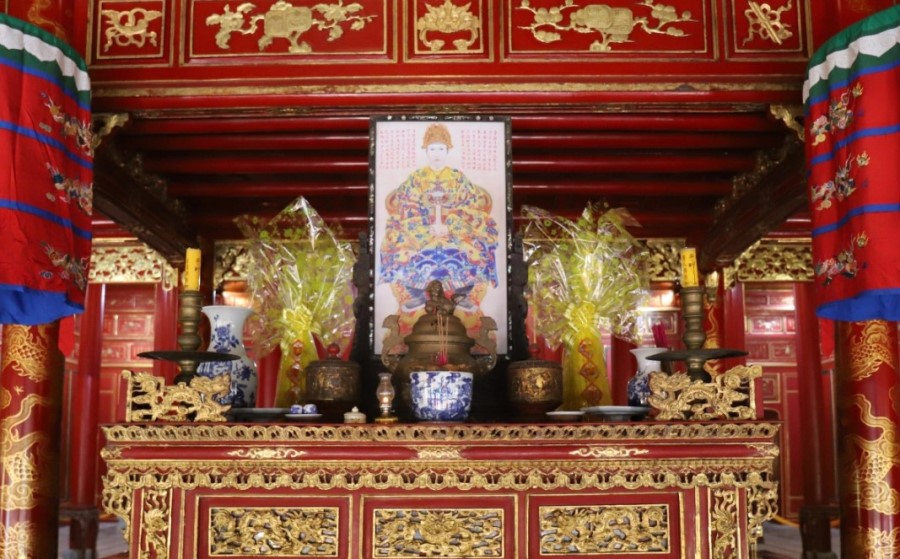
Visitors are often deeply impressed by Trung Hy Temple, which is considered a remarkable repository of traditional Vietnamese lacquer art and gilded decoration. The intricate craftsmanship found here highlights the high level of artistry achieved during that period.
The Burial Area
The tomb area of Dong Khanh Tomb is oriented toward the East–Southeast, with Thien Thai Mountain serving as its front screen. While the temple area retains traditional Vietnamese characteristics, the tomb itself reflects a strong Western influence.
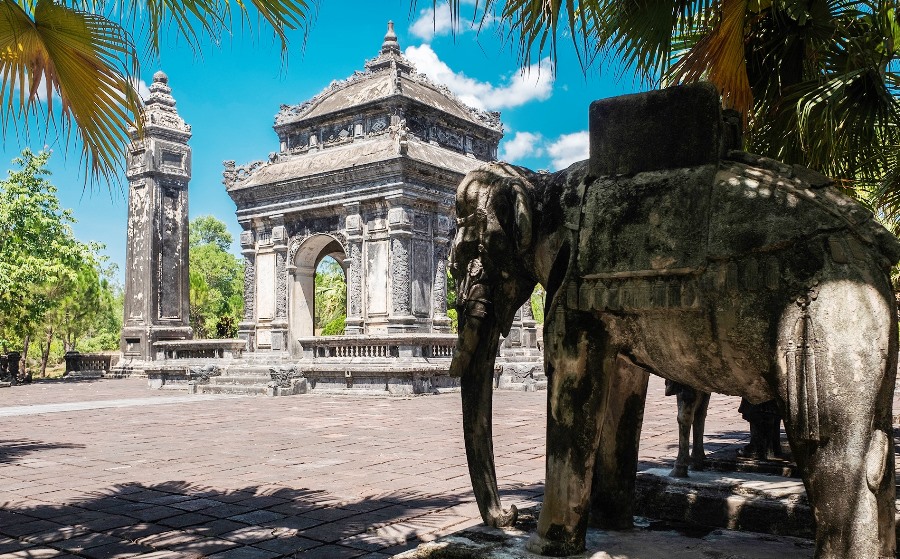
From decorative motifs and architectural lines to construction materials, the tomb shows clear signs of Europeanization. This contrast between the two sections of the complex further emphasizes Dong Khanh Tomb as a unique intersection of Eastern heritage and Western innovation.
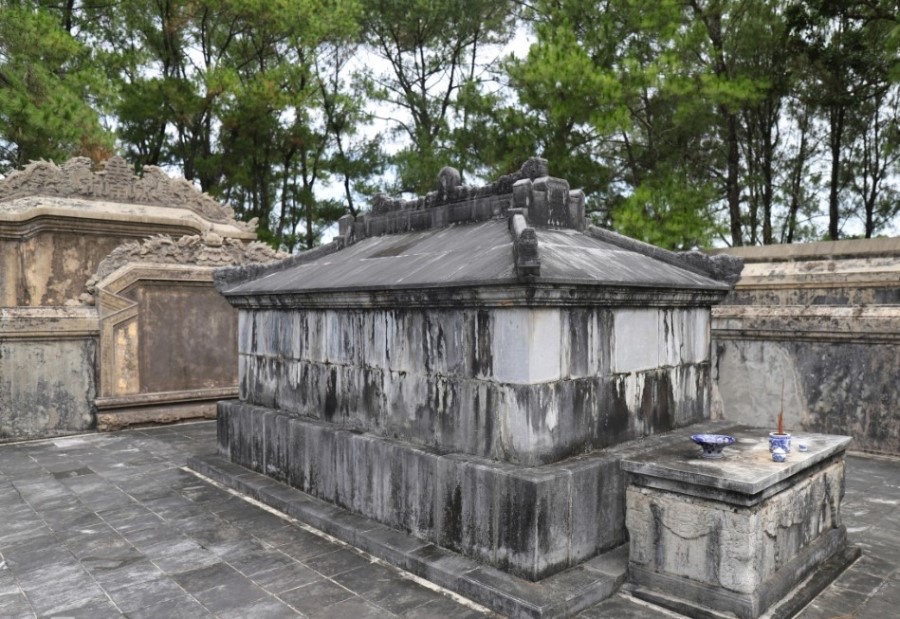
Visitors can also notice many adaptations of European architecture blended with traditional Asian elements, such as tall, slender mandarin statues made of cement and brick instead of stone, and the use of ardoise (slate) tiles in place of traditional yellow glazed imperial tiles.
Highlights of Dong Khanh Tomb
Dong Khanh Royal Tomb Artistic Value
Constructed and completed over a long period of 35 years, the tomb of Emperor Dong Khanh bears the imprint of two distinct architectural styles from different historical periods. While traditional architecture reached its peak at Tu Duc Tomb and modern influences were later clearly expressed in Khai Dinh Tomb, Dong Khanh Tomb represents a transitional stage between the two.

Among its structures, Ngung Hy Temple is considered one of the finest places preserving the art of lacquer and gilded decoration, as well as traditional Vietnamese lacquer painting. This makes the tomb not only historically significant but also highly valuable in terms of artistic heritage.
Peaceful and Less Crowded Atmosphere
Compared to popular sites like Khai Dinh Tomb, Dong Khanh Tomb receives fewer visitors, making it ideal for those who prefer a quieter and more intimate experience.
Historical Significance
The tomb reflects a pivotal moment in Vietnamese history when the country was undergoing major political and cultural changes under colonial rule.
Dong Khanh Tomb Travel Tips
✓ Wear comfortable clothing and walking shoes, as the site involves some walking.
✓ Bring water, sunscreen, and a hat, especially during hot months.
✓ Respect the historical and spiritual significance of the site by maintaining quiet and appropriate behavior.
✓ Combine your visit with nearby attractions like Tu Duc Tomb and Thuy Xuan Incense Village for a richer experience.
Best Time to Visit
The ideal time to visit Dong Khanh Tomb is during the dry season from March to August, when the weather in Hue is sunny and suitable for outdoor exploration. Early morning or late afternoon visits are recommended to avoid heat and enjoy softer lighting for photography.
Entrance Fee and Opening Hours
- Opening hours:
✓ 7:30 AM – 5:30 PM, from Monday to Sunday
- Entrance fee:
✓ 100,000 VND per adult
✓ 50% discount for local residents of Hue
✓ Free for children aged 7–12
These details help visitors plan their trip more conveniently when exploring the Dong Khanh Tomb.
Nearby Attractions
Tu Duc Tomb
One of the most beautiful royal tombs in Hue, this site is known for its poetic landscape of lakes, pavilions, and gardens. Built by Emperor Tu Duc, it reflects a romantic and philosophical lifestyle. The harmony between nature and architecture makes it a must-visit. Visitors can enjoy peaceful walks and scenic views throughout the complex.
Khai Dinh Tomb
Famous for its dramatic architecture, Khai Dinh Tomb showcases strong European influences with intricate mosaics and bold designs. It stands out for its elaborate interior decorations and impressive stairways. The tomb reflects the emperor’s admiration for Western culture. It offers a completely different experience compared to traditional tombs.
Thuy Xuan Incense Village
This traditional craft village is known for its colorful incense sticks and long-standing heritage. Visitors can learn about the incense-making process and interact with local artisans. The vibrant displays make it a popular spot for photography. It also offers insight into Hue’s cultural traditions.
Conclusion
Dong Khanh Tomb is more than just a royal burial site; it is a reflection of a transformative era in Vietnamese history. With its unique blend of traditional and Western architectural elements, peaceful setting, and cultural significance, the tomb offers a distinctive experience among Hue’s royal monuments.
For travelers exploring Hue, this lesser-known gem is well worth a visit to gain a deeper understanding of the country’s rich and evolving heritage.