
Introduction
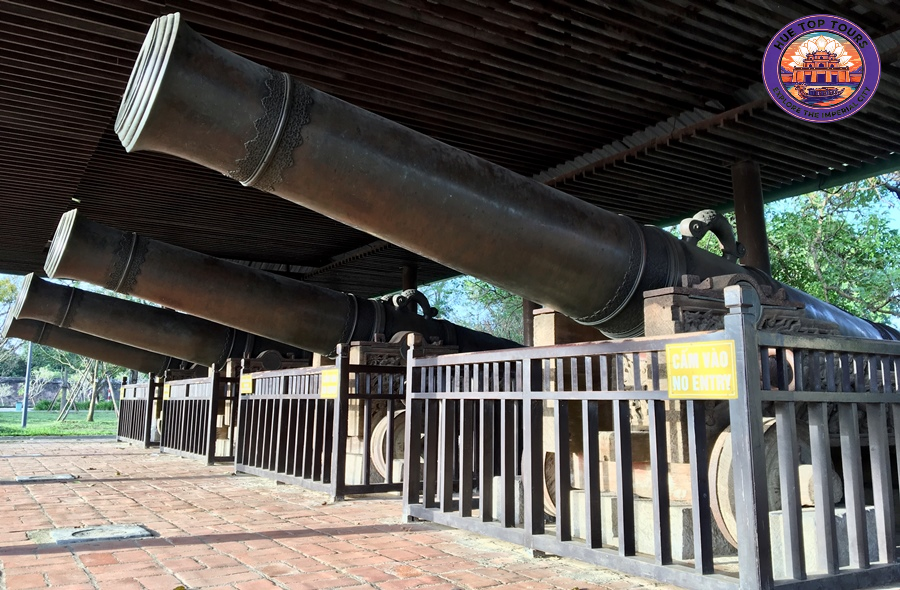
The Nine Holy Cannons (Cửu Vị Thần Công) are among the most impressive military artifacts preserved under the Nguyen Dynasty (1802–1945). Cast in the early 19th century under the reign of Emperor Gia Long, these massive bronze cannons are not only weapons of war but also powerful symbols of royal authority, national unity, and spiritual protection.
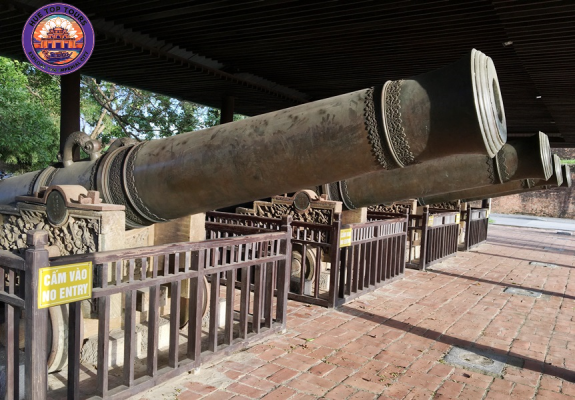
Nowadays, the Nine Holy Cannons stand solemnly at the Hue Imperial Citadel, symbolizing the power and legitimacy of Vietnam’s last feudal dynasty. Join Hue Top Tours to discover more about this remarkable National Heritage treasure of Vietnam.
History Of The Nine Holy Cannons
After defeating the Tay Son Dynasty and unifying Vietnam in 1802, Emperor Gia Long sought to consolidate his power and safeguard the new capital, Phu Xuan (Hue). In 1803–1804, he ordered the casting of nine enormous bronze cannons using captured weapons and bronze from previous regimes.
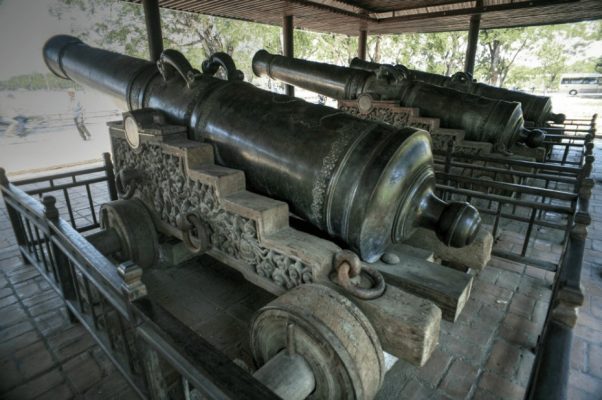
Rather than being made for frequent combat, these cannons were created as symbolic guardians of the imperial capital. The Nguyen court officially recognized them as sacred objects, bestowing each cannon with a divine title and associating them with the Four Seasons and the Five Elements in Eastern philosophy. Because of this spiritual status, they became known as the Nine Holy Cannons.
Describe The Nine Holy Cannons
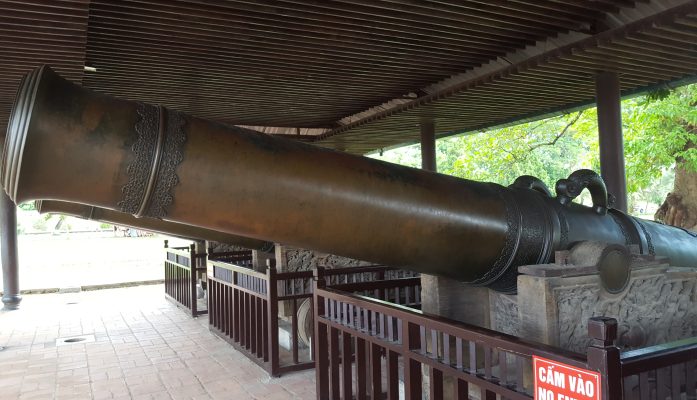
The Nine Holy Cannons are monumental bronze artillery pieces, meticulously cast with refined craftsmanship. Each cannon rests on a fixed stone base and faces outward, symbolizing protection against external threats.
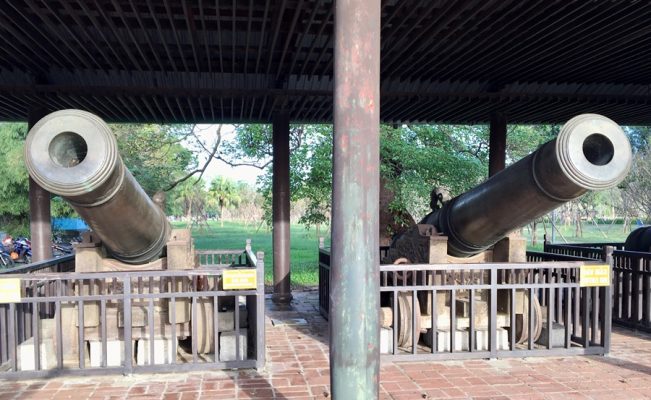
Although they resemble functional cannons, historical records show that they were rarely, if ever, used in actual warfare. Their main purpose was ceremonial and symbolic, demonstrating the military power, prosperity, and divine mandate of the Nguyen emperors.
Name Of The Cannons
The nine cannons are divided into two symbolic groups:
Four Cannons Representing the Four Seasons:
- Xuân (Spring)
- Hạ (Summer)
- Thu (Autumn)
- Đông (Winter)
Five Cannons Representing the Five Basic Elements to create the Universe:
- Kim (Metal)
- Mộc (Wood)
- Thủy (Water)
- Hỏa (Fire)
- Thổ (Earth)
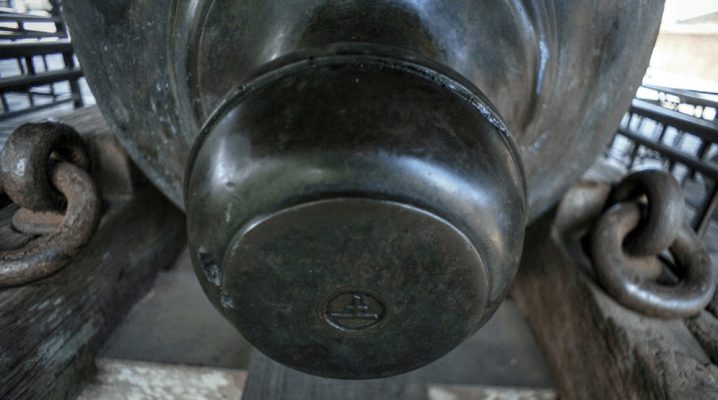
The name of each cannon is carefully embossed on the knob at the rear of the gun, reflecting traditional Eastern cosmology that emphasizes harmony between heaven, earth, nature, and imperial rule.
Nine Holy Cannons Location: Past & Present
Originally, the Nine Holy Cannons were placed on the outer rampart of the Imperial Citadel, on the left side of Ngo Mon Gate. The barrels faced outward, toward the south, to protect the citadel. This area was known as Ta Xuong General, also called the Royal Cannon Workshop, where weapons were produced for the Nguyen court.
During the reign of Emperor Tu Duc, nine more cannons were cast in a similar style but slightly smaller in size. These smaller cannons were placed on the right side of Ngo Mon Gate and were later sent for military use in Gia Dinh, Son Tra (Da Nang), and Thuan An (Hue).
In 1917, under the reign of Emperor Khai Dinh, all Nine Holy Cannons were moved out of the Imperial Citadel to the Ky Dai (Flag Tower) area, where they remain today. They are arranged in two facing groups:
- The group on the left, behind Ngan Gate, includes four cannons named after the four seasons: Spring, Summer, Autumn, and Winter (from inside to outside).
- The group on the right, behind Quang Duc Gate, includes five cannons named after the five elements: Metal (Kim), Wood (Moc), Water (Thuy), Fire (Hoa), and Earth (Tho).
Size Of The Cannons
Each cannon is about 5.1 meters long.
- Inner barrel diameter: 22 meters
- Outer barrel diameter at the middle: 54 meters
The wooden gun carriage measures:
- 75 meters long
- 73 meters high
Each wheel of the cannon base has a diameter of 0.62 meters.
How Much Does It Weigh?
The weight of the Nine Holy Cannons was calculated using Vietnam’s ancient measurement system. The exact weight of each cannon was measured during casting and engraved directly on its body.
- Xuan (Spring): over 17,700 kg
- Ha (Summer): over 17,200 kg
- Thu (Autumn): over 18,400 kg
- Dong (Winter): over 17,800 kg
- Moc (Wood): over 17,100 kg
- Hoa (Fire): over 17,200 kg
- Tho (Earth): over 17,800 kg
- Kim (Metal): over 17,600 kg
- Thuy (Water): over 17,200 kg
Patterns On The Body
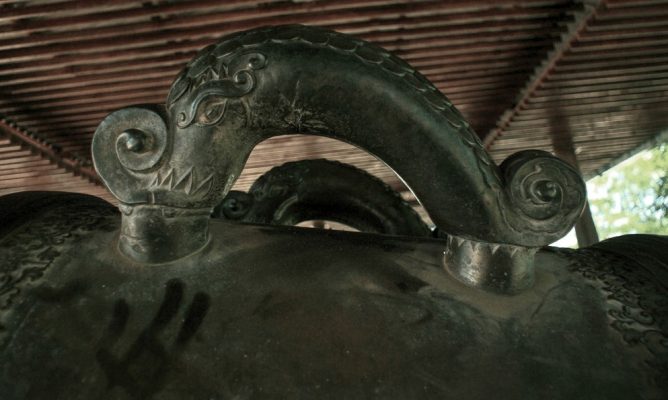
The body of each cannon is richly decorated with eight bands of floral patterns running around the barrel. In the middle section, there are two large engraved bands featuring unicorns, symbolizing power and protection.
Near the rear block of each cannon, there are two rows of Chinese characters:
- The upper row reads “Menh Gia Long”, meaning it was made by order of King Gia Long.
- The lower row is divided into two parts:
- The right side shows the official title and rank of the cannon.
- The left side records the year it was granted its sacred title.
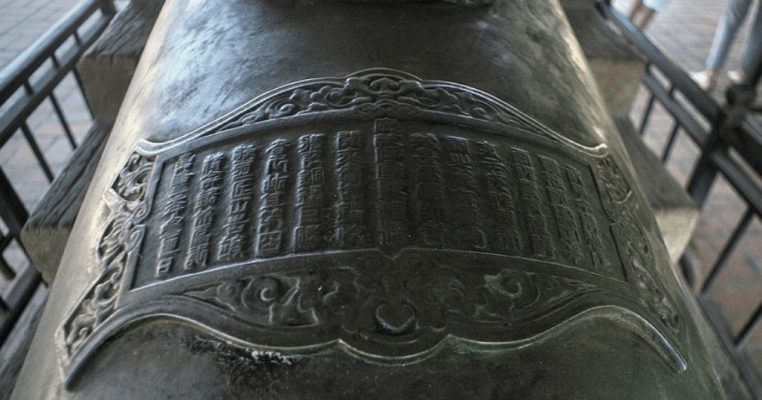
Above this area, about 14 cm above the decorative strap, the cannon body also includes the names and titles of four officials who were members of the royal council in charge of casting the cannons.
How To Operate It
Each cannon has written instructions engraved on its body, explaining how it was meant to be used. To fire a cannon, gunpowder was loaded in four layers.
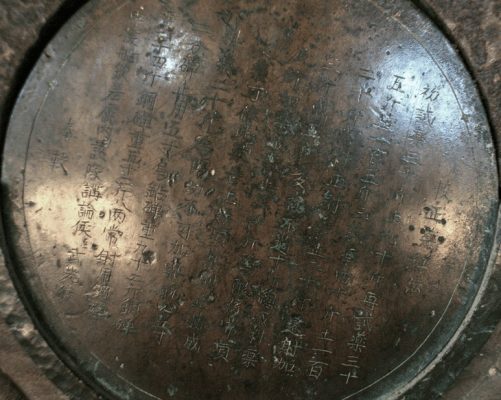
- The first layer used about 30 pounds of gunpowder mixed with 40 pounds of soil.
- The second layer included 30 pounds of gunpowder and 105 pounds of soil.
- The third layer contained 40 pounds of gunpowder and 120 pounds of soil.
- The fourth layer used 20 pounds of gunpowder to fire the projectile.
If a stronger shot was needed, the amount of gunpowder in the fourth layer could be increased to up to 30 pounds, creating the most powerful blast. These detailed instructions show that the cannons were carefully designed and fully functional, even though they were rarely used in real combat.
Value Of The Nine Holy Cannons
The Nine Holy Cannons were regarded as sacred guardians of the city and were believed to protect the imperial capital. Beyond their spiritual role, they are also outstanding works of bronze craftsmanship in the Hue Imperial Citadel.
Together with the Nine Dynastic Urns (Cửu Đỉnh) and other bronze masterpieces, the Nine Holy Cannons are considered national treasures, representing not only the heritage of Hue but also the cultural and historical pride of Vietnam as a whole.