

Introduction
Ngo Mon Gate, also known as Meridian Gate or The Noon Gate, is the grand main entrance to the Imperial City of Hue and one of the most iconic architectural symbols of the Nguyen Dynasty. More than just a gateway, Ngo Mon Gate represented royal power, strict court hierarchy, and the ceremonial heart of Vietnam’s last feudal capital.
Standing majestically at the southern entrance of the Hue Citadel, this historic structure has witnessed important royal events, military parades, and historic moments in Vietnamese history. These days, Ngo Mon Gate welcomes visitors from around the world to explore the former imperial capital, offering a deep insight into Hue’s royal past.
Location of Ngo Mon Gate
Ngo Mon Gate is located at the southern side of the Imperial City of Hue, within the Hue Citadel complex in Hue city, Central Vietnam.
It directly faces the Flag Tower (Ky Dai) across the main square and serves as the principal entrance leading into the royal palace area. From here, visitors can easily access major attractions such as:
- Thai Hoa Palace
- The Forbidden Purple City
- Royal courtyards and temples
Its central position made Ngo Mon Gate the most important gateway of the entire imperial complex.
During your stay in Hue city, you may need our Hue Tours and Hue Private Cars transfer services, such as
- Sunrise On Tam Giang Lagoon Tour– from 21 USD/ pax.
- Sunset On Tam Giang Lagoon Tour– from 21 USD/ pax.
- Cooking Class At Thuy Bieu Village Tour– from 52 USD/ pax.
- Hue Airport Transfer– from 14 USD/ sedan car.
- Hue to DMZ By Private Car– from 58 USD/ Sedan car.
Special Architecture of Ngo Mon Gate
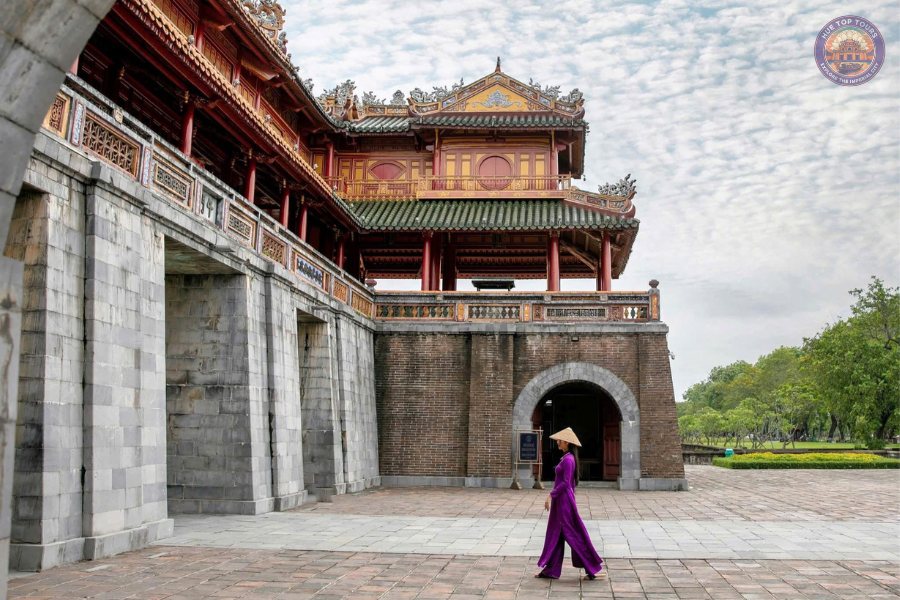
Ngo Mon Gate is a masterpiece of traditional Vietnamese imperial architecture combined with defensive design. The structure consists of two main parts:
The Stone Base Platform
The lower section of Ngo Mon Gate is a massive U-shaped stone platform, built from large solid bricks and stone blocks, rising approximately 5 meters high. This sturdy foundation was not only designed to support the elegant Five-Phoenix Pavilion above but also to serve as a defensive structure protecting the inner Imperial City.
The platform stretches widely across the southern entrance of the Citadel and is pierced by five large arched entrances, each carefully designed with a specific purpose that reflected the strict social order of the Nguyen Dynasty.
At the very center is the main gate, the widest and most elevated passage, reserved exclusively for the Emperor. This central entrance symbolized the supreme authority of the monarch, representing the “Mandate of Heaven” in Confucian philosophy. No one else, not even high-ranking officials, was permitted to pass through this gate. It was used only during the Emperor’s official ceremonies, royal processions, and important national events.

Flanking the central gate on both sides are two medium-sized entrances, known as the “Mandarin Gates.” These were reserved for high-ranking court officials, scholars, and members of the royal family during formal occasions. Their placement close to the Emperor’s gate emphasized their elevated status within the court hierarchy while still clearly distinguishing them from the supreme ruler.
On the outermost sides are two smaller gates, often referred to as the “Soldiers’ and Elephant Gates.” These were designed for guards, servants, and the royal elephants that played a role in military parades and royal ceremonies. Elephants were a symbol of royal power and strength in Vietnamese culture, and their inclusion in the gate system demonstrates how architecture was adapted to accommodate ceremonial animals as well as people.
Beyond social symbolism, the stone platform also had a strategic defensive role. Its thick walls and elevated height made it difficult for enemies to breach the inner palace. The arched gates could be easily guarded and controlled, allowing imperial soldiers to monitor all movement in and out of the Citadel.
Architecturally, the stonework showcases the advanced construction techniques of the Nguyen Dynasty. The bricks were tightly fitted without modern cement, relying on traditional bonding methods that have allowed the structure to endure for nearly two centuries despite war and weather.

Overall, the stone base platform of Ngo Mon Gate was both:
- A strong defensive foundation protecting the Imperial City
- A ceremonial structure guiding royal processions
- A symbolic expression of Confucian hierarchy and imperial power
Through its grand scale, careful layout, and solid construction, the stone platform embodied the authority, order, and stability of the Nguyen Dynasty, making it a crucial architectural and historical element of Ngo Mon Gate.
The Five-Phoenix Pavilion (Lau Ngu Phung)
On top of the stone platform stands the elegant wooden pavilion called Five-Phoenix Pavilion, featuring:
- Yellow-glazed roof tiles symbolizing royal authority
- Upturned roof corners shaped like phoenix wings
- Red lacquered wooden columns with intricate carvings
The pavilion served as a ceremonial viewing platform where the Emperor observed important events such as military parades and royal celebrations. The harmonious combination of strength from the stone base and grace from the wooden pavilion creates a balanced architectural beauty.

The Function of Noon Gate
Ngo Mon Gate was far more than a simple entrance to the Imperial City. It served as a central stage for royal authority, political power, ceremonial life, and military control during the Nguyen Dynasty.
First and foremost, Ngo Mon Gate functioned as the main ceremonial gateway of the Imperial City. All important royal processions passed through this gate, including the Emperor’s official appearances, coronation parades, and court rituals. The layout of the five entrances strictly reflected social hierarchy: only the Emperor was allowed to use the central gate, high-ranking mandarins entered through the inner side gates, while soldiers, servants, and animals used the outer passages. This architectural design reinforced the rigid class structure of feudal Vietnam.
Secondly, the gate acted as a royal platform for public announcements and national celebrations. From the Five-Phoenix Pavilion above, the Emperor would appear before the court and citizens to proclaim new laws, announce important decisions, or celebrate major events such as Lunar New Year, royal birthdays, military victories, and successful imperial examinations. These gatherings were not only political events but also cultural spectacles, showcasing the power and prestige of the monarchy.

Ngo Mon Gate also served as a symbolic bridge between the royal world and the common people. While the Imperial City itself was a restricted space reserved for the royal family and officials, ceremonies held at Ngo Mon Gate allowed the Emperor to present himself to the public. This helped reinforce loyalty and respect among the population while maintaining the mystique of imperial authority.
In addition to its ceremonial role, Ngo Mon Gate played an important defensive and administrative function. The massive stone platform, thick walls, and elevated position helped protect the inner palace from potential attacks. Guards were stationed here to control access, inspect visitors, and maintain security. During times of political tension, the gate could be closed and defended as a stronghold.
Historically, the gate also became the setting for some of Vietnam’s most significant moments. The most famous event occurred in 1945, when Emperor Bao Dai officially abdicated here, transferring power to the new revolutionary government. This marked the end of over a thousand years of monarchy in Vietnam, giving Ngo Mon Gate lasting national historical significance.
Meridian Gate History and Cultural Value
Ngo Mon Gate was constructed in 1833 during the reign of Emperor Minh Mang, one of the most influential Nguyen rulers.
Over nearly two centuries, the gate has witnessed:
- Royal processions and court rituals
- Political changes during the late Nguyen Dynasty
- The historic abdication ceremony of Emperor Bao Dai in 1945
This moment marked the end of Vietnam’s feudal monarchy and the beginning of a new era. Nowadays, Ngo Mon Gate stands as a powerful symbol of Hue’s imperial heritage and is recognized as part of the UNESCO World Heritage Site – Complex of Hue Monuments.

How to Get There
Ngo Mon Gate is centrally located within the Hue Imperial Citadel, right in the heart of Hue City, making it very easy and convenient for visitors to access. From most hotels and homestays in the city center, the gate is only about 2 kilometers away, which usually takes around 10- 15 minutes by taxi, private car, or motorbike, depending on traffic.

For travelers who enjoy a slower and more scenic approach, you can also walk or cycle along the Perfume River toward the Citadel. This pleasant route allows you to admire local daily life, riverside scenery, and historic surroundings before reaching the main entrance of the Imperial City.
To fully understand the historical significance and architectural details of Ngo Mon Gate, many visitors choose to explore it as part of a guided tour. You can easily book a Hue City Private Tour, Hue City Group Tour, or a more in-depth Hue Imperial Citadel Walking Tour via Hue Top Tours. These tours are led by knowledgeable local guides who provide rich historical stories, cultural insights, and flexible itineraries, helping you make the most of your visit while comfortably covering all major highlights of the Citadel complex.
Choosing a guided tour not only saves time but also allows you to gain a deeper appreciation of Ngo Mon Gate’s role in royal ceremonies, imperial life, and Vietnamese history.

Useful Travel Tips
- Wear comfortable walking shoes, as the Citadel complex is large
- Visit early morning or late afternoon to avoid heat and crowds
- Bring water and sun protection in the summer months
- Respect cultural heritage by not climbing restricted areas
- Consider hiring a guide to fully understand the historical stories

Why Ngo Mon Gate Is a Must-Visit in Hue
Meridian Gate is not only an architectural highlight but also a gateway into Vietnam’s royal history. Its grand design, symbolic layout, and historical significance make it one of the most impressive structures in the Hue Citadel. Whether you are interested in history, culture, architecture, or photography, Ngo Mon Gate offers a meaningful and unforgettable experience.