

Introduction
Duyet Thi Duong Royal Theater – the oldest royal theater in Vietnam. It is situated within the Hue Imperial Citadel, which is a unique cultural heritage site closely tied to the history of the Nguyen Dynasty. This theater is not only a venue for performing traditional court arts such as opera, dance, and ceremonial music, but also a vivid testament to the essence of ancient Vietnamese theater.

With its unique architecture, long-standing historical value, and profound cultural significance, Duyet Thi Duong has become an attractive destination for tourists exploring the ancient capital of Hue. This article from Hue Top Tours will help you gain a deeper understanding of the origins, architecture, role, and engaging experiences associated with this ancient theater.
History of Duyet Thi Duong Royal Theater
From The Beginning
In 1826, King Minh Mạng officially ordered the construction of Duyet Thi Duong Royal Theater on the former site of Thanh Phong Duong (1805). The initial purpose of this theater was to provide a venue for the King, royal relatives, high-ranking officials, and foreign dignitaries to enjoy the arts, particularly royal court plays.
Duyet Thi Duong was renovated once in 1829 (the 10th year of Minh Mang’s reign). After that, there were many more renovations and repairs, but not much change. In 1833, the court of Emperor Minh Mang minted the “Minh Mang Phi Long” coins right here.
Duyet Thi Đuong was also used to host major events such as the King’s 40th birthday celebration. Many kings held their grand birthday parties here, including Minh Mạng, Tự Đức, Đồng Khánh, and Khải Định.
Changes Over Time

After the August 1945 Revolution, the Duyet Thi Duong Royal Theater ceased operations and no longer hosted royal events. Furthermore, the Royal Theater suffered significant damage throughout the war.
Until 1962, the government of the Republic of Vietnam converted it into a teaching facility for the Hue National School of Music. Between 1995 and 2002, the Vietnamese government undertook a significant restoration effort to preserve its architecture and cultural heritage.

Finally, since 2003, it has been officially reopened, serving as a stage for Hue royal court music and traditional opera performances for tourists. Thanks to the tireless efforts of archaeologists, architects, and artisans, the theater’s unique architecture has been restored to its original splendor.
In 2004, the Hue Imperial City Relics Museum Center restored and began operating the Hue royal court music performances for tourists. The theater has collected and restored eight out of eleven ancient dances, forty court music pieces, and numerous excerpts from ancient plays.

These included many elaborately staged performances such as the Thai Binh Drum, Tam Luan Cuu Chuyen (grand music), Phu Luc Dich, Kim Tien (small music), Vu Phien, Luc Cung Hoa Dang, and excerpts from the plays Ky Lan Anh, On Dinh Chem Ta, Luc Cung Hoa Dang, Nu Tuong Xuat Quan, Lan Mau Xuat Lan Nhi… and typical excerpts from the Royal Court plays Son Hau and Tam Nu Do Vuong.
Visitors can go inside to explore, and if they arrive at the right time, they can watch traditional plays and court music performances.
The Unique Architecture of Hue Royal Theater

Duyet Thi Duong has a total area of 11,740 m2. Of this, the theater building occupies 1,182 m2. The entire structure is constructed from aged ironwood, stands 12 meters tall, and has two floors. The whole grounds of the theater were previously used to cultivate rare and valuable medicinal plants.
To the right of the theater is the Royal Medical Institute, where medicines were prepared for the King and the royal family. To the left is the Imperial Kitchen, where meals were prepared for the King. Both are separated from the theater by a wall.

Marcel Monnier recorded the shape and layout of the Hue Royal Theater in his book “Le tour d’Asie” (Plan, Paris 1898). It describes what he saw and heard at a theatrical performance at Duyet Thi Duong in 1898, on the occasion of the 17th birthday of King Thanh Thai.
“The stage was rectangular, with a curved roof resembling that of temples and pagodas, supported by rows of massive lacquered wooden pillars. The theatre was built leaning against the Imperial Palace, where the King and the royal ladies resided. These ladies watched the performances from a high gallery that occupied almost the entire rear of the theatre. In front of their gallery hung a bamboo curtain. Through that soft, movable screen, the ladies sat hidden in a dim light, from which they could look out without fear of being seen. They chatted lightly, their whispers like birds in a cage, mingled with the fluttering sound of fans like wings beating. The rustle of silk garments, the metallic chime of jewelry clashing, the tinkling of golden chains, and occasionally a burst of laughter – childlike laughter quickly restrained – followed by a long silence.

The decoration of the theatre was truly harmonious: Vietnamese dragons appeared everywhere, carved on wooden frames or winding around the pillars. The ceiling was painted azure blue (couleur azur), adorned with stars and symbols of the Imperial Palace.
The wooden furnishings were arranged with excellent symmetry. At the foot of the gallery reserved for the Empress Dowager and the royal ladies, the throne stood alone on its pedestal. Further back, on both sides of the stage, were long benches covered in dark crimson fabric for court officials, members of the Resident Superior’s Office, and the Privy Council. Seated there was the last venerable representative of Emperor Gia Long’s reign, Prince Tuy Lý – the eleventh son of Emperor Minh Mạng. Beside him sat Nguyễn Trọng Hợp – the third regent, who truly held executive power. All dignitaries wore badges on their chests – a kind of golden plaque suspended by a red silk cord. Their brocade garments were embroidered with flowers in dazzling colors. The scene was further embellished by the evening meal laid out on a long table, with many delicious cakes lovingly prepared by the royal ladies for the King and honored guests.
The attendants, dressed in short red tunics, moved gracefully with bare feet, pouring wine with the same reverence as altar boys serving in church.
In truth, there was no stage at all – nothing separated reality from the performers. The actors moved in harmony with the audience within a vast square space arranged directly before the throne and the seats of the officials. The decoration followed an ancient style: a wall with two doors – one for exiting on the left and one for entering on the right.
Such a stage allowed the spectators to partake in the very world of art.”
According to Marcel Monnier’s account in his book “Le tour d’Asie” (Plan, Paris, 1898), the Duyet Thi Duong Royal Theater was not only a ceremonial venue but also a showcase for traditional theatrical art.
Duyet Thi Duong Royal Theater Address And Ticket Price

Duyet Thi Duong Theater is situated within the grounds of the Hue Imperial Citadel, so visitors only need to purchase tickets at the Ngo Mon Gate to enter. The entrance fee is 200,000 VND for adults and 40,000 VND for children aged 7 to 12 years old. The entrance fee includes access to Duyet Thi Duong Theater.
In addition, the theater also hosts daily performances of Nha Nhac (court music), court dances and songs, as well as court opera. The ticket price to watch the show is 200,000 VND per person.
- Morning: 10:00 – 10:35
- Afternoon: 15:00 – 15:35
Experiences When Visiting Duyet Thi Duong
Watch the Art Performance
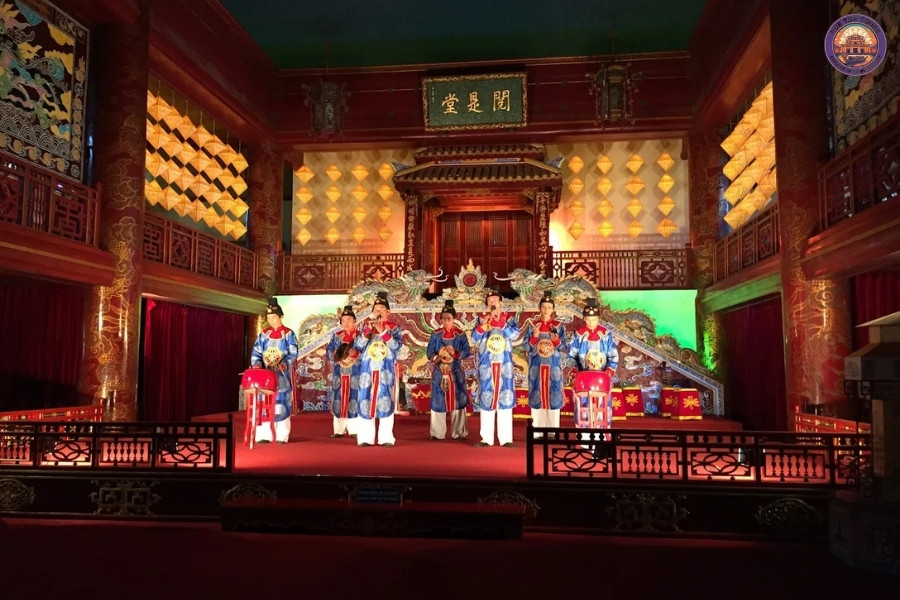
Imagine yourself as a high-ranking official or royal relative when visiting Duyet Thi Duong and watching famous court music performances. The seats that were previously reserved only for dignitaries and the performances that were exclusive to them are now available for visitors to sit in and watch freely.

Performances are held regularly, from 10:00 – 10:35 and 15:00 – 15:35. Hue Royal Court Music, an intangible cultural heritage recognized by UNESCO, offers visitors the opportunity to see works such as the Thai Binh Drum, the Luc Cung Hoa Dang, and excerpts from classical plays like Ky Lan Anh and Phan Le Ba. These performances are meticulously restored and staged, providing a profound artistic experience.
Besides reviving classic works, the theater also creates many new works based on traditional materials, bringing freshness to the audience. Among them, the play “The Entrepreneur of the Southern Region” has been highly appreciated by the public.
Join a Tour with a Tour Guide
Visiting Duyet Thi Duong Theater with a professional tour guide will help visitors learn more about its fascinating history. The guide will introduce and explain the theater in more detail, from the stage and royal spaces to the areas reserved for actors.
In addition to learning about history, art, and architecture, guides will share fascinating stories about past events with visitors. However, to hire a guide, visitors can book the Hue Imperial City Walking Tour service offered by Hue Top Tour.
Hunting for Beautiful Photos

If you’re traveling, one experience you definitely shouldn’t miss is taking stunning commemorative photos. With its exquisite royal architecture, from the gilded pillars to the delicate carvings, you’ll have the opportunity to capture moments that are both ancient and elegant, reminiscent of the Hue imperial court.
Additionally, visitors can rent traditional costumes to take nostalgic photos. Rental prices range from approximately 150,000 to 600,000 VND, depending on the outfit. Visitors can easily get beautiful images by renting elegant ao dai dresses or other magnificent traditional costumes.
Visit the surrounding landmarks.

Besides the Duyet Thi Duong Royal Theater, the surrounding area offers many other worthwhile attractions. Since you’ve already paid for an entrance ticket, why not take the opportunity to visit some of the buildings within the Hue Imperial Citadel?
- Sở Thượng Thiện (Imperial Kitchen): Located in the northeast, this is where food is prepared and supplied to the royal family, and also handles tasks related to imperial cuisine.
- Thái Y Viện (Imperial Medical Institute): Located in the southeast, this was where the imperial physicians worked, examining and caring for the health of the emperor, members of the royal family, and officials.
- Thị Vệ Trực Phòng (The Royal Guard’s Duty Room): Located in the southeast corner, this is where the royal guards are always stationed to protect the King.
- Cẩn Tín Ty (Internal Administrative Office): The internal office of the Forbidden City, where internal administrative tasks were handled.
- Tiên Trượng Khố (Imperial Seal Repository): A place where the King’s insignia were kept and used on grand occasions.
- Dưỡng Chính Đường (Hall of Cultivation): Located south of the theater, this was where the princes lived and studied.
Conclusion
The Duyet Thi Duong Royal Theater is not only a unique architectural masterpiece within the Hue Imperial Citadel complex, but also a vivid testament to the court art of the Nguyen Dynasty. When visiting Hue, tourists will have the opportunity to admire the ancient beauty, enjoy traditional art performances, and experience the essence of ancient court culture firsthand.
Hue Top Tours thanks you for taking the time to read and learn about the ancient Hue Imperial City Theater. We hope that the information provided in this article will be helpful to you.
If you’re looking for a complete journey exploring Hue’s cultural heritage, let Hue Top Tours be your companion. We are committed to providing quality travel experiences that will help you gain a deeper understanding of the history, art, and identity of this ancient capital city.