

Overview of the Nine Dynastic Urns
The Nine Dynastic Urns (Cửu Đỉnh) are among the most remarkable cultural and artistic treasures of the Hue Imperial City. Cast entirely in bronze, these monumental urns stand as enduring symbols of national unity, imperial authority, and the Nguyen Dynasty’s vision of a stable and prosperous Đại Nam (Great Vietnam).
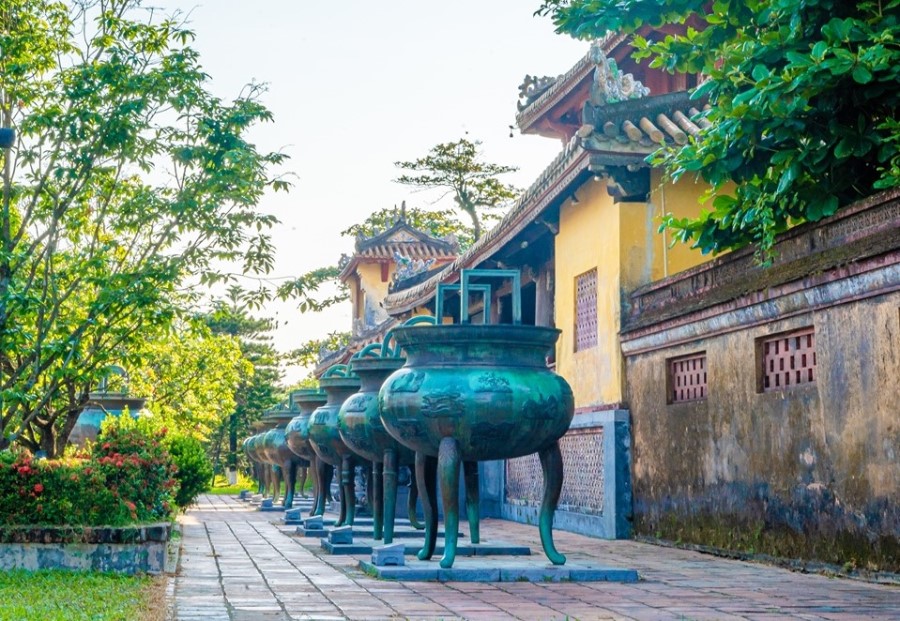
Located solemnly in front of the The Mieu Temple, the Nine Dynastic Urns are not merely decorative objects but profound historical records carved in metal, reflecting geography, natural resources, cosmology, and the worldview of Vietnam in the 19th century.
Historical Background of the Nine Dynastic Urns
The Nine Dynastic Urns were commissioned by Emperor Minh Mang and cast between 1835 and 1837. This period marked the peak of the Nguyen Dynasty’s centralization, when the emperor sought to consolidate power, reinforce national unity, and affirm Vietnam’s territorial sovereignty.

Inspired by ancient Chinese traditions where nine bronze tripods symbolized supreme royal authority, Emperor Minh Mang adapted this concept to Vietnamese conditions, transforming it into a uniquely Vietnamese cultural statement rather than a mere imitation.
The Meaning of “Cửu Đỉnh” in Eastern Philosophy
In Eastern philosophy, the number nine (cửu) represents completeness, eternity, and supreme power. It is the highest single-digit number and traditionally associated with emperors.

The word “đỉnh” refers to large ceremonial bronze vessels used in royal rituals. Combined, Cửu Đỉnh symbolizes the eternal legitimacy of imperial rule and the continuity of the Nguyen Dynasty across generations.
Location of the Nine Dynastic Urns in the Hue Imperial City
The Nine Dynastic Urns are arranged symmetrically in front of the The To Mieu Temple, where the Nguyen emperors were worshipped. Each urn is positioned in alignment with a specific emperor, reinforcing the spiritual connection between the dynasty’s founders and their successors.
This strategic placement underscores the sacred role of the urns as guardians of royal heritage and national memory.
Scale, Materials, and Bronze Casting Techniques
These nine monumental bronze urns are remarkably large in scale, averaging 2.3 meters in height and weighing between 1.9 and 2.6 tons each. The urns are named Cao Đỉnh, Nhân Đỉnh, Chương Đỉnh, Anh Đỉnh, Nghị Đỉnh, Thuần Đỉnh, Tuyên Đỉnh, Dụ Đỉnh, and Huyền Đỉnh. Each name corresponds to the temple name (miếu hiệu) of a Nguyen emperor and is associated with the respective ancestral altar inside Thế Miếu (The Mieu Temple).

On the front of each urn, inscriptions in relief record its name, year of casting, and weight. Surrounding the body of each urn are 17 relief images, arranged in three horizontal tiers- upper, middle, and lower, encircling the entire surface.

The carved motifs include natural elements such as the sun, moon, and stars; landscapes such as mountains, rivers, estuaries, and mountain passes; as well as flowers, animals, local products, weapons, and transportation means. Together, these images reflect the ancient Vietnamese worldview and philosophy of life, while also serving as historical and legal testimony affirming the sovereignty, prosperity, unity, and richness of the nation.

All 162 relief carvings across the Nine Dynastic Urns are independent artistic compositions. They represent a masterful fusion of bronze casting and relief engraving techniques, forming what can be regarded as an encyclopedic record of Vietnamese life in the first half of the 19th century. In recognition of their exceptional historical, cultural, and artistic value, the Nine Dynastic Urns were officially designated a National Treasure of Vietnam in 2012 by the Prime Minister.
Symbolic Imagery System on the Nine Dynastic Urns
It can be seen that the artisans of Emperor Minh Mang’s reign presented, in a concise yet comprehensive manner, the remarkable diversity of landscapes and natural features across the country, thereby portraying the richness and vitality of the nation. The reliefs depict celestial bodies such as stars and constellations; mountains and rivers; estuaries and territorial waters; mountain passes and border gates; trees and flowers; animals; weapons; and boats and vehicles.

For example, while the Tuyên Đỉnh features the Red River, the Huyền Đỉnh bears the image of the Mekong River (Cửu Long River), and the Nhân Đỉnh represents the Perfume River. Similarly, if the Cao Đỉnh shows a tiger in the forest, the Nhân Đỉnh displays a whale beneath the sea. All these images portray landscapes and elements that were authentic and intimately familiar to the Vietnamese people.

Among the motifs on the Nine Dynastic Urns are also images associated with the difficult and turbulent years of the Nguyen Dynasty’s founding. One notable example is the Nam Trân tree (lòn bon fruit) carved on the Nhân Đỉnh. The lòn bon fruit, known for its sweetness, grows abundantly in the forests of Quảng Nam and is still widely sold in markets in Quang Nam, Danang, and Hue today.

According to legend, in the late 18th century, when the Tây Sơn forces pursued Nguyễn Phúc Ánh (Emperor Gia Long) and took refuge near the headwaters of the Vu Gia River in the forests of Quảng Nam, he survived by eating this fruit. After ascending the throne as Emperor Gia Long, he renamed the tree “Phụng Quân Mộc” (the tree that supports the king). It is likely for this reason that Emperor Minh Mang ordered the image of the lòn bon tree to be engraved on the Nhân Đỉnh.

In addition, Emperor Minh Mang had a crocodile carved on the Chương Đỉnh, recalling the legend that Nguyễn Phúc Ánh once crossed a river and was saved from capture when crocodiles blocked his enemies’ pursuit. Another legend recounts that when he fled by sea to Thổ Chu Island, his boat was kept from capsizing by a sacred serpent that stabilized it.

All the images cast in relief on the Nine Dynastic Urns represent regional characteristics stretching from North to South Vietnam. Beyond their imperial symbolism, the motifs also carry strong folk elements, closely connected to the everyday life of ordinary Vietnamese people in rural villages.

Alongside valuable timber trees such as ironwood, cinnamon, and pine, the urns also depict common agricultural crops and herbs familiar to the population, including rice, betel vine, jackfruit, scallions, turmeric, perilla leaves, and peanuts.
Nine Dynastic Urns and Nguyen Dynasty Royal Ideology
For Emperor Minh Mang, the Nine Dynastic Urns were political statements cast in bronze. They symbolized centralized authority, moral governance, and the unity of the empire under one ruler. Rather than celebrating conquest, the urns emphasize harmony, order, and continuity, key principles of Confucian governance.
Historical, Cultural, and Artistic Value
The Nine Dynastic Urns of Hue and the Nguyễn Emperors
The Nine Dynastic Urns (Cửu Đỉnh), cast under Emperor Minh Mạng in 1835–1837, stand before Thế Miếu (the Temple of Generations) in the Imperial City of Huế. They are sacred dynastic treasures symbolizing imperial authority, unity, and the permanence of the Nguyễn dynasty.
Arranged symmetrically with Cao Đỉnh at the center, the urns are positioned opposite the altars of specific emperors. Each urn was named after the posthumous title (thụy hiệu) of a Nguyễn ruler. For example, Cao Đỉnh corresponds to Emperor Gia Long (Thế Tổ Cao Hoàng Đế), Nhân Đỉnh to Minh Mạng (Thánh Tổ Nhân Hoàng Đế), Chương Đỉnh to Thiệu Trị, and Anh Đỉnh to Tự Đức. However, because several later emperors were deposed or exiled and did not receive official posthumous titles, the names Dụ Đỉnh and Huyền Đỉnh did not ultimately become imperial posthumous names.
An Illustrated Encyclopedia of Vietnam
More than decorative objects, the Nine Urns function as a visual encyclopedia of 19th-century Vietnam. Among 162 relief motifs cast on the urns, 90 depict distinctive Vietnamese flora and fauna. The 54 plant images include food crops, fruit trees, spices, timber, and medicinal plants, while the animal motifs portray fish, birds, quadrupeds, insects, and mythical creatures.
These detailed carvings vividly reflect the country’s biodiversity and may be considered an early symbolic “Red Book” of Vietnam’s natural heritage.
Maritime Sovereignty and International Significance
The urns also depict rivers, mountains, and seas, including the East Sea, Southern Sea, and Western Sea on the three largest urns. These representations, together with other historical documents, serve as valuable evidence of Vietnam’s long-standing maritime sovereignty, including over the Hoàng Sa (Paracel) and Trường Sa (Spratly) archipelagos.
Written in classical Chinese, the scholarly language of East Asia at the time, the Nine Urns have regional cultural significance. No similar set exists in other East Asian imperial palaces, making them unique even in a comparative perspective.
A Masterpiece of Bronze Casting
The Nine Urns represent the pinnacle of 19th-century Vietnamese bronze casting. Crafted entirely by hand, each mold was unique and destroyed after casting, ensuring that no replica could be made. The process took nearly seven months and required extraordinary technical precision.
Today, the Nine Dynastic Urns remain irreplaceable cultural treasures, monuments to imperial power, artistic excellence, and Vietnam’s historical identity.
Useful Travel Tips
The best way to visit
Visitors can admire the Nine Dynastic Urns while exploring the Huế Imperial City. Located in front of Thế Miếu within the Citadel complex, the urns stand in a solemn and contemplative space where travelers can observe the intricate bronze reliefs up close and appreciate their symbolic depth.
To fully understand the historical, political, and cultural meanings embedded in each urn, joining a guided experience is highly recommended. Popular options include the Hue City Tour 1 Day, which covers major highlights of the Imperial City and royal tombs; the Hue City Group Tour, ideal for travelers seeking a structured and budget-friendly itinerary; and the Hue Imperial City Walking Tour provided by Hue Top Tours, which offers a more in-depth exploration of the Citadel, including a detailed interpretation of the Nine Dynastic Urns and The To Mieu Temple.
With expert guidance, visitors gain deeper insight into the craftsmanship, symbolism, and national significance that make the Nine Dynastic Urns one of the most remarkable treasures of Vietnam’s imperial heritage.
Opening Hours and Entrance Ticket
The Nine Dynastic Urns are accessible daily from 7:00 AM to 5:00 PM as part of the Hue Imperial City complex. There is no separate entrance fee; access is included in the Imperial City ticket.
Tips for Visiting and Photography
Morning and late afternoon provide the best lighting for photography, revealing fine relief details on the bronze surface. Visitors are encouraged to move slowly, observe each urn individually, and read the symbolic imagery as a narrative rather than isolated images.
Nearby Attractions to Combine with the Nine Dynastic Urns
The Nine Dynastic Urns can be conveniently combined with visits to Ngo Mon Gate, Thai Hoa Palace, Truong Sanh Residence, Dien Tho Palace, Duyet Thi Duong Royal Theater, and Kien Trung Palace, creating a comprehensive journey through the Nguyen Dynasty’s political, ceremonial, and daily life.