

Truong Sanh Residence Overview
Truong Sanh Residence is a lesser-known yet historically significant architectural complex located within the broader system of royal structures associated with the Nguyen Dynasty in Hue. Unlike palaces used for official ceremonies or royal governance, Truong Sanh Residence reflects the private living, spiritual, and cultural aspects of royal life, offering visitors a deeper understanding of how Nguyen emperors and royal family members balanced daily life, beliefs, and nature.

Nestled in a quiet setting that harmonizes with the surrounding landscape, Truong Sanh Residence stands as a subtle symbol of longevity, peace, and continuity, values deeply rooted in Eastern philosophy and Confucian thought. These days, it attracts travelers who are interested in exploring Hue beyond the main tourist highlights, seeking authenticity and historical depth.
Truong Sanh Palace Historical Background
From a historical perspective, the architectural appearance and functions of Truong Sanh Palace during the Nguyen Dynasty, from 1822 to 1945, can be divided into five major developmental phases. Each phase reflects transformations over time as well as the impact of significant historical events.
Truong Sanh Palace under the Reign of Minh Mang (1820–1840)
When Emperor Minh Mang ascended the throne, his mother, Empress Dowager Thuan Thien Cao, resided at Dien Tho Palace. In 1822, in order to provide her with a place for rest and leisure, Emperor Minh Mang ordered the construction of a separate garden-style residence located next to Dien Tho Palace. This space was designed to allow her to relax, enjoy the surrounding scenery, and maintain her health and longevity.
The palace, named Truong Ninh, was completed in 1823, with the name meaning “long-lasting tranquility.” The complex consisted of numerous structures, including the main hall, rear pavilion, Xuyen Duong House, Di Chi House, Vong Ho Pavilion, Tuy An House, along with palace gates, enclosing walls, ponds, wooden bridges, artificial rockeries, and landscaped hills—together forming a serene and peaceful environment. Nearby stood Ho Tam Pavilion, located beside the Inner Kim Thuy Lake.
Truong Sanh Palace under the Reign of Thieu Tri (1841–1847)
In 1845, the Nguyen royal family celebrated a momentous occasion when Emperor Thieu Tri welcomed his first grandson. His son, Prince Hong Bao, had a son named Ung Dao, marking the rare event known as “Ngu Dai Dong Duong”—five generations living under one roof.
To commemorate this joyful occasion, Emperor Thieu Tri ordered the renovation and embellishment of Truong Sanh Palace, renaming several structures within the complex. The main building was renamed “Ngu Dai Dong Duong Hall.” The renovated complex included the Ngu Dai House, Tho Khang Hall, and Van Phuc Pavilion, all connected by covered corridors arranged in the shape of the Chinese character “王” (king). The surrounding landscape featured Kinh Ngu Rock, Ho Ton Hill, Dao Nguyen Stream, and elegant decorative bridges.
Emperor Thieu Tri also selected this site as one of the Twenty Scenic Beauties of the Imperial Capital (Than Kinh) and composed the poem “Truong Ninh Thuy Dieu” to praise its meaningful beauty.
Truong Sanh Palace under the Reign of Dong Khanh (1886–1888)
During the Fall of the Imperial Capital in 1885, the three Empress Dowagers—Tu Du, Le Thien, and Hoc Phi—fled together with Emperor Ham Nghi. After returning to Hue, in January 1886, Emperor Dong Khanh ordered the restoration and refurbishment of Truong Ninh Palace so that Empress Dowager Le Thien could reside there.
This marked the first and only time the palace’s function was altered—from a leisure and retreat space into a permanent residential palace.
Truong Sanh Palace under the Reign of Duy Tan (1907–1916)
After Emperor Duy Tan ascended the throne and Emperor Thanh Thai was placed under house arrest, the two Empress Dowagers—Nguyen Gia Thi Anh and Nguyen Thi Dinh—resided in neighboring halls within Dien Tho Palace.
Around 1910, long-standing tensions between the two women escalated into open conflict. To resolve the situation, the Privy Council (Vien Co Mat) allocated funds and instructed the Ministry of Public Works to mobilize soldiers and craftsmen to renovate Truong Ninh Palace. The palace was then designated as the residence of Nguyen Thi Dinh, Emperor Duy Tan’s biological mother, creating physical distance between the two empress dowagers.
Truong Sanh Palace under the Reign of Khai Dinh (1916–1925)
During this period, Empress Dowager Tien Cung Duong Thi Thuc (1868–1944) resided at the palace. The most significant event occurred in 1923, when, in preparation for Emperor Khai Dinh’s 40th birthday Grand Celebration the following year, Truong Ninh Palace underwent another major renovation and was officially renamed Truong Sanh Palace, meaning “Long Life.”
Although Truong Sanh Palace was fortunate to escape destruction during wartime, more than 80 years of harsh weather and human impact gradually caused the monument to deteriorate and lose much of its former grandeur.
After decades of decline due to climate and war, the palace fell into serious disrepair. However, from 2006 to 2010, the site underwent a major restoration project with an investment of approximately 30 billion VND, restoring the palace according to its appearance during the reigns of Khai Dinh and Bao Dai. Today, Truong Sanh Palace stands as an attractive and meaningful historical site within the Hue Imperial City.
Architectural Features of Truong Sanh Residence
Architecturally, Truong Sanh Residence follows traditional Nguyen Dynasty design principles, characterized by symmetry, balance, and harmony with nature. The layout is carefully planned, often aligned along a central axis, with buildings arranged in a way that respects both functional needs and symbolic meanings.

Key architectural elements include wooden structures, tiled roofs with gentle curves, and decorative motifs inspired by nature, such as clouds, flowers, and mythical creatures. The use of natural materials not only enhanced durability but also reflected the Nguyen belief in living in harmony with the environment. Despite its relatively modest scale compared to major palaces, Truong Sanh Residence demonstrates refined craftsmanship and thoughtful spatial organization.
Feng Shui Significance of Truong Sanh Residence
Feng shui played a crucial role in the selection and design of Truong Sanh Residence. The residence was positioned to achieve an ideal balance between mountains, water, and open space, elements believed to influence health, fortune, and spiritual energy.

The orientation of buildings, pathways, and courtyards was carefully calculated to allow positive energy to flow smoothly while minimizing disruptive forces. In traditional Eastern philosophy, such arrangements were essential for promoting longevity and inner peace, which aligns perfectly with the symbolic meaning of “Truong Sanh.” This feng shui-conscious design makes the residence not just a physical space, but a spiritual environment.
Cultural and Spiritual Values
Beyond its architectural beauty, Truong Sanh Residence holds deep cultural and spiritual significance. It reflects the Nguyen Dynasty’s worldview, where political power was inseparable from moral virtue and spiritual balance. Daily life within the residence often involved rituals, meditation, and practices aimed at maintaining harmony between body and spirit.

The residence also embodies Confucian ideals such as filial piety, respect for ancestors, and disciplined living. These values shaped not only royal life but also influenced Vietnamese society for generations. Visiting Truong Sanh Residence today allows travelers to gain insight into the spiritual mindset of Vietnam’s last imperial dynasty.
What to See at Truong Sanh Residence
Visitors to Truong Sanh Residence can explore a variety of architectural and cultural elements that reveal its historical role. Highlights include the main hall, secondary living quarters, courtyards, and remnants of decorative details that once adorned the structures.
Phuong Mon Gate
Phuong Mon, the main gate of Truong Sanh Palace, is one of the site’s most distinctive architectural highlights, showcasing the refined craftsmanship of Nguyen Dynasty construction. The gate was designed in the tam quan style (The Three-door gate), a traditional architectural form commonly found in royal palaces, temples, and ceremonial complexes during Vietnam’s feudal period.

The tam quan structure features three entrances: the central gate reserved exclusively for the emperor, while the two side gates were used by court officials and royal guards. This layout clearly reflects the strict hierarchical order and ceremonial regulations of the Nguyen court.
Decorative elements on the gate consist primarily of delicately carved floral motifs, symbolizing elegance, prosperity, and the flourishing nature of the Nguyen Dynasty. When harmoniously integrated with the surrounding landscape, the main gate serves not only as an entrance but also as a powerful symbol of dignity and aesthetic balance, contributing to the overall solemn beauty of Truong Sanh Palace within the Hue Imperial City.
The Feng Shui Screen
The Feng Shui Screen at Truong Sanh Residence was built to protect the palace from negative energy and to maintain harmony within the overall architectural layout. Positioned directly behind the main gate, it follows traditional Nguyen Dynasty feng shui principles by blocking direct energy flow and creating a sense of balance and privacy.

The screen is typically decorated with symbolic motifs representing longevity, prosperity, and good fortune. Beyond its spiritual function, the feng shui screen also enhances the residence’s sense of solemnity and refined elegance.
Truong Du Pavilion
Truong Du Pavilion is a unique architectural structure within the Hue Imperial City, once serving as a private retreat for the Empress Dowager. Located beside a picturesque lake, Truong Du Pavilion exudes a sense of tranquility and serenity, creating an ideal space for rest and scenic contemplation by members of the royal family.

The pavilion was built in a traditional architectural style, featuring simple yet refined decorative elements that blend harmoniously with the surrounding natural environment.
The calm waters of the lake reflect the image of the pavilion, combined with lush greenery to form a peaceful and poetic landscape. Beyond being a place of relaxation, the pavilion also held spiritual significance, offering the royal family a quiet setting for reflection and inner balance amid the pressures of court life.
Truong Du Pavilion is an important component of the overall architectural complex of the Imperial City, exemplifying the harmonious integration of nature and classical Vietnamese architectural art.
Tho Khang Palace
Serving as the principal residence of Truong Sanh Residence, it was the most important architectural structure within the complex. It functioned as the primary living and resting space for members of the royal family, especially the Empress Dowager, during different periods of the Nguyen Dynasty.

Designed in a traditional Nguyen architectural style, the building features a symmetrical layout, wooden columns, and gently curved tiled roofs that convey elegance and harmony. Beyond its residential role, the main house also reflected the values of longevity, tranquility, and refined royal living.
Ta Vu and Huu Vu Pavilions
At Truong Sanh Residence, the two buildings flanking the main house on the left and right sides follow the traditional Nguyen Dynasty layout and are commonly identified as the Left House (Ta Vu) and Right House (Huu Vu).

These auxiliary structures were used to support the daily functions of the main residence, serving as spaces for attendants, court ladies, storage, or preparation related to royal living and rituals.
Their symmetrical placement on either side of the main house reflects Confucian principles of balance, hierarchy, and order in imperial architecture. Together with the main house, the Ta Vu and Huu Vu form a harmonious architectural ensemble that defines the core living area of Truong Sanh Residence.
Van Phuc Pavilion
Van Phuc Pavilion is a refined architectural structure within the Truong Sanh Residence complex, with its name meaning “Ten Thousand Blessings.” True to its symbolic name, the pavilion represented wishes for prosperity, happiness, and longevity for the royal family.

Built in a traditional Nguyen Dynasty style, Van Phuc Pavilion was typically used as a place for rest, contemplation, and enjoying the surrounding landscape. It is highlighted by an artificial rockery system at the rear and a continuous covered corridor that links the various halls together, creating a harmonious and well-connected architectural layout.
Its elevated position and open design allowed gentle breezes and scenic views, making it an ideal space for relaxation and spiritual reflection.
Dao Nguyen Moat System
Dao Nguyen moat is a small, gently winding water channel that curves around and encloses the central area of Truong Sanh Residence (formerly Truong Ninh Garden) within the Hue Imperial City, creating a poetic landscape and auspicious feng shui setting. The stream is connected to Noi Kim Thuy Lake to the north, and several elegant red-painted bridges span across it, adding visual charm and symbolic meaning.

Dao Nguyen Stream surrounds key architectural structures such as Ngu Dai Dong Duong Hall, Van Phuc Pavilion, and a series of artificial rockeries, including Bao Son, Kinh Ngu, and Ho Ton. The stream was intentionally designed to create a harmonious “mountain-and-water” (son thuy huu tinh) landscape, perfectly suited to the function of Truong Sanh Residence as a place for relaxation, leisure, and scenic enjoyment (thuong tiet uu du) for the Nguyen emperors and the Empress Dowager.
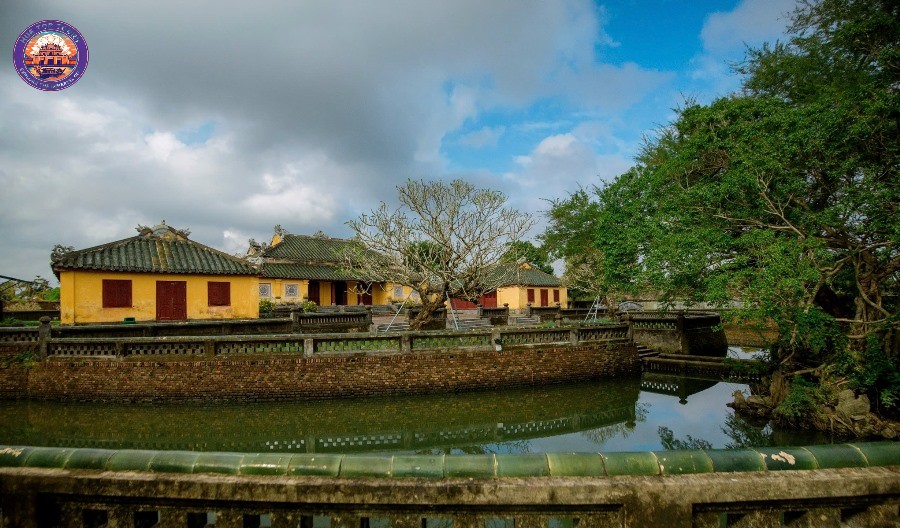
Together with the rockery system and surrounding architectural works, Dao Nguyen Stream forms a distinctive royal garden complex characterized by balance, tranquility, and refined aesthetics. According to the Hue City Portal, Truong Sanh Residence was ranked seventh among the scenic landmarks of the Imperial Capital (Than Kinh) by Emperor Thieu Tri, highlighting its exceptional landscape value.
Over time, war and harsh weather conditions caused significant deterioration to Truong Sanh Residence and its landscape system, including Dao Nguyen Stream. From 2005 to 2007, extensive restoration and conservation efforts were carried out to revive the original appearance of the stream and its surrounding garden scenery, allowing visitors today to once again appreciate the poetic beauty and feng shui harmony of this royal retreat.
Useful Travel Tips
Entrance Fee and Opening Hours
There is no separate entrance ticket required specifically for Truong Sanh Residence. Access to the site is included in the Hue Imperial City entrance ticket, allowing visitors to explore Truong Sanh Residence as part of their overall visit to the Imperial City.
Opening hours are daily from 7:00 AM to 5:00 PM. Visitors are recommended to arrive earlier in the day to enjoy the site in a quieter atmosphere and to allow sufficient time for exploration within the Imperial City complex.
Best Time to Visit Truong Sanh Residence
The best time to visit Truong Sanh Residence is during the dry season, from March to August, when weather conditions are favorable for walking and outdoor exploration. Early mornings or late afternoons offer cooler temperatures and softer lighting, enhancing the overall experience.
Visiting during quieter hours also allows travelers to fully appreciate the peaceful atmosphere and spiritual essence of the site without interruptions.
How to Get to Truong Sanh Residence
Truong Sanh Residence is conveniently located within the Hue Imperial City and is easily accessible from the Hue city center by private car, taxi, motorbike, or on foot once inside the Citadel. The short journey allows visitors to pass through peaceful streets and green spaces, offering a gentle introduction to Hue’s calm and historic atmosphere.
For a more insightful experience, visitors may choose to explore Truong Sanh Residence as part of a Hue city private tour, Hue city group tour, Hue Imperial Citadel walking tour, or a Hue city tour by private car. These guided options provided by Hue Top Tours are ideal for travelers who wish to better understand the historical context, architectural details, and feng shui significance of the residence, while enjoying a well-paced and informative visit to Hue’s imperial heritage.
Truong Sanh Palace Dress Code
Visitors should dress modestly and respectfully, as Truong Sanh Residence is closely connected to royal and spiritual traditions. Comfortable footwear is recommended due to walking paths and uneven surfaces.
Bringing water, sun protection, and a camera will enhance your visit, especially during warmer months. Most importantly, take time to observe quietly, this is a place best appreciated at a slow and thoughtful pace.
Nearby attractions
Truong Sanh Residence can be conveniently combined with visits to other nearby royal and cultural sites in Hue, such as
Dien Tho Residence
Dien Tho Residence was the living quarters of the Empress Dowagers during the Nguyen Dynasty and is one of the most important residential complexes within the Imperial City. The architecture reflects dignity, balance, and refined royal living, closely connected to Truong Sanh Residence in both function and history.
Ngo Mon Gate (Meridian Gate)
Ngo Mon Gate is the grand southern entrance to the Hue Imperial City and one of its most iconic landmarks. This ceremonial gate was reserved for important royal events and symbolizes imperial authority and power.
Thai Hoa Palace
Thai Hoa Palace served as the most important ceremonial hall of the Nguyen Dynasty, where coronations and major court ceremonies took place. The palace stands out for its majestic scale, red lacquered columns, and symbolic dragon decorations.
Duyet Thi Duong Theater
Duyet Thi Duong is the oldest surviving royal theater in Vietnam, once used exclusively for performances for the emperor and royal family. Today, it offers visitors insight into traditional court music and classical performances of the Nguyen era.
Kien Trung Palace
Kien Trung Palace is a unique architectural masterpiece that blends traditional Vietnamese design with Western influences. It once served as a private residence for Emperor Khai Dinh and Emperor Bao Dai, reflecting the transition period of the late Nguyen Dynasty.