

Truong Tien Bridge Overview
Gracefully spanning the poetic Perfume River, Truong Tien Bridge is one of the most iconic landmarks in Hue. Located in the heart of the city, the bridge connects the northern and southern banks, linking historical sites with modern urban life.

More than just a means of transportation, Truong Tien Bridge represents the soul of Hue- gentle, romantic, and deeply rooted in history. Whether you visit during the day or at night, the bridge offers a unique perspective of the city’s tranquil beauty, making it an essential stop on any Hue itinerary.
Its Location
The Trang Tien Bridge, also known as Truong Tien Bridge, is located in the south of Hue city, connecting the two banks of the Perfume River between Phu Xuan and Thuan Hoa wards.
This bridge is not only an important transportation structure but also a distinctive symbol of the dreamy city of Hue, closely associated with its cultural and historical beauty.
History of Truong Tien Bridge
Similar to Long Bien Bridge spanning the Red River in Hanoi, Truong Tien Bridge was the first bridge to cross the Perfume River in Hue, located right next to the Imperial Citadel.
It is also one of the earliest bridges built in Indochina in the late 19th and early 20th centuries, constructed using modern Western engineering techniques and steel materials. Before that, most bridges were short and made of bamboo or wood, which were not durable.

Originally, the official name of the steel bridge over the Perfume River was Thanh Thai, later changed to Clémenceau and then Nguyen Hoang. However, since there used to be a royal mint of the Nguyen Dynasty located on the left bank near the bridge, local people became accustomed to calling it Truong Tien Bridge, a name that has remained ever since.
In the autumn of 1896, Emperor Thanh Thai issued a royal decree to construct a steel bridge, emphasizing:
“Benevolent governance places nothing above bringing benefits to the people. Recently, the construction of roads and bridges has been carried out to improve public convenience. Now, following the report of the Privy Council, the road in front of the Perfume River is an important route. It is therefore necessary to build a steel bridge to facilitate transportation. However, due to the high cost, careful planning and preparation are still required.”
According to writer Buu Y (80 years old, from Phu Hoi Ward, Hue City), building a bridge across the Perfume River at that time was not an easy task, as the river itself was known for its poetic and romantic beauty.
“Construction conditions in those days were far more limited than today. Hue faced a real challenge: how to build a bridge that would make travel easier for people while carefully avoiding a structure that might appear too rigid and disrupt the natural charm of the landscape,” he explained.
One year after Emperor Thanh Thai issued the decree to build a steel bridge, in April 1897, Governor-General of Indochina Paul Doumer arrived in Hue and worked with the royal court to focus investment on creating a durable, long-lasting structure.
The emperor ordered the Ministry of Finance to allocate 190,000 silver coins, while the remaining cost was covered with support from the French. The construction of the bridge was assigned to the Eiffel company.
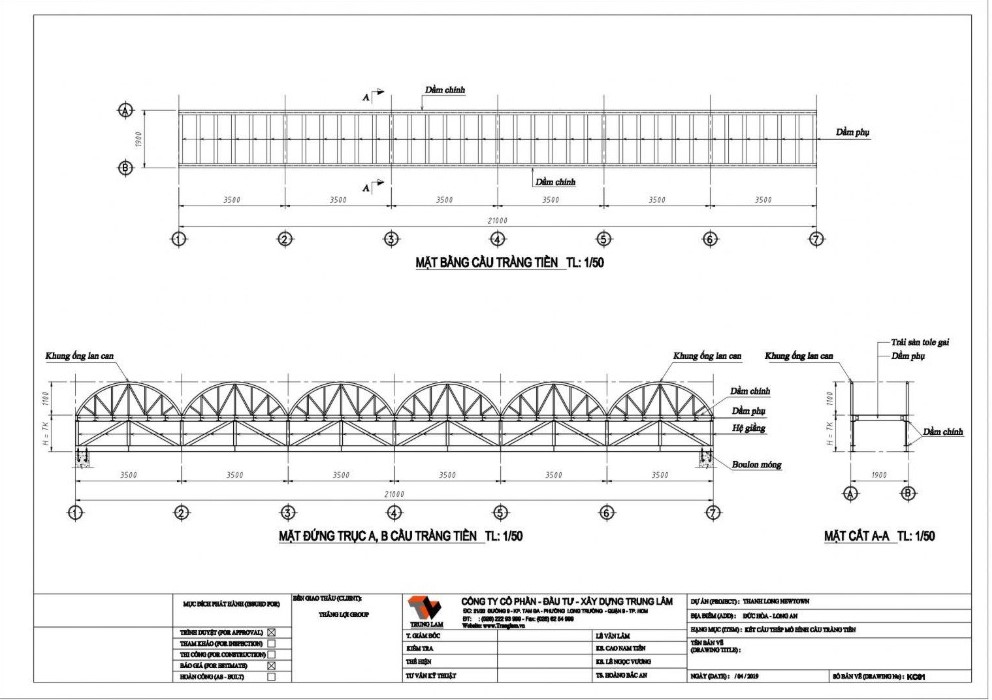
When construction of the Truong Tien Bridge began, Emperor Thanh Thai personally laid the foundation stone. After two years, the bridge, featuring six steel spans shaped like ivory combs (semi-circular arches) and a deck paved with ironwood planks, was completed.
People in Hue are familiar with the folk verse: “Truong Tien Bridge with six spans and twelve sections…” In fact, the bridge has six spans and twelve segments connected into six pairs. The bridge measures just over 400 meters in length between its two abutments; including the approach roads, its total length is approximately 453 meters, with a width of six meters. At the time of its completion, the bridge did not yet include sidewalks for pedestrians.
Since its completion in 1899, the people of Hue have witnessed Truong Tien Bridge collapse into the Perfume River three times.
“It is perhaps the bridge that has suffered the most collapses and reconstructions in Vietnam,” said writer Buu Y.
When it was first completed, Truong Tien Bridge was a solid steel structure built with advanced Western engineering techniques, making both the authorities and the contractors extremely proud.
However, just five years later (in 1904, the Year of the Dragon), a historic storm struck and destroyed much of the bridge. Of its six spans, four were swept down into the river. In 1906, the bridge was repaired, and the deck was upgraded to concrete instead of the original ironwood planks.
In 1937, during the reign of Emperor Bao Dai, the bridge underwent a major renovation. Notably, pedestrian walkways were added on both sides, along with ten viewing balconies for sightseeing.

On December 19, 1946, following the resistance strategy of scorched-earth tactics, Truong Tien Bridge was deliberately blown up to halt the advance of French troops. At 2 a.m., a powerful explosion shook the entire city. One section of the bridge was lifted into the air before collapsing, misaligned by up to three meters from the adjacent span. This marked the beginning of the resistance war in Hue.
It was not until 1953 that the bridge was fully reconstructed in its original form.
Thirteen years later, during the Tet Offensive in the spring of 1968, Truong Tien Bridge was destroyed once again. On the night of February 7, 1968, one ton of explosives brought down the fourth span and completely destroyed the third pier. A temporary wooden pontoon bridge was later installed between the third and fourth spans to restore basic passage.
“After Thang Long Bridge Company No. 1 carried out a major restoration of the bridge between 1991 and 1995, the name ‘Trang Tien’ was installed at the bridge’s entrance. Following this latest phase of restoration and repair, the original name ‘Truong Tien’ will be officially reinstated,” said Mr. Dang Nguyen Ngoc Linh, Deputy Head of Sub-Department II.6 under the Road Management Division 2 (Directorate for Roads of Vietnam, Ministry of Transport).
Unique Architecture of Truong Tien Bridge
With a total length of 402.6 meters, a height of 5.45 meters, and a width of 6 meters, Truong Tien Bridge stands as a remarkable architectural masterpiece in the heart of Hue. Designed in a distinctive French style, the bridge features elegant lines, graceful arches, and refined structural details. With its impressive scale and unique design, the bridge is not only an important transportation route but also a cultural symbol and a defining highlight of Hue City.

Truong Tien Bridge is admired not only for its delicate beauty but also for its distinctive structure. The bridge is divided into six main spans, each composed of two connected sections, forming a total of twelve segments. This design not only enhances its aesthetic appeal but also ensures structural stability by effectively distributing weight and pressure across the bridge.
In addition, the numbers six and twelve are often considered lucky in Eastern culture. The division of the bridge into six spans and twelve segments, therefore, carries not only technical significance but also reflects a symbolic wish for peace and prosperity. The entire bridge is constructed from steel, a modern material at the time, which contributes to its durability and ability to withstand harsh weather conditions.
Truong Tien Bridge in Hue Culture & Daily Life
Through many ups and downs of history, with its graceful charm, Truong Tien Bridge and the poetic Perfume River have become an endless source of inspiration for artists and writers.

According to writer Buu Y, anyone from Hue can easily recite these familiar folk verses:
- Cầu Trường Tiền sáu vài mười hai nhịp
- Em theo không kịp, tội lắm, anh ơi!
- Bấy lâu mang tiếng chịu lời
- Anh có xa em đi nữa, cũng tại ông Trời nên xa.
In 1905, when the bridge was reconstructed using reinforced concrete, another verse emerged:
- Chợ Đông Ba đem ra ngoài giại
- Cầu Trường Tiền đúc lại xi-moong
- Ơi người lỡ hội chồng con
- Về đây gá nghĩa vuông tròn nước non…
In 1941, during his time in Hue, poet Nguyễn Bính likened the gentle curve of the bridge, then painted in a shimmering silver color, to an ivory comb:
- “…The bridge curves like an ivory comb,
- The river flows like the soft hair of a graceful maiden…”
For locals, the bridge is part of everyday life—a place for morning walks, evening strolls, and quiet reflection. You will often see students in white ao dai cycling across the bridge, creating a scene that feels both nostalgic and poetic.
The bridge symbolizes the gentle rhythm of Hue life, where time seems to slow down, allowing visitors to fully absorb the city’s peaceful atmosphere.
How to Get There
Truong Tien Bridge is centrally located, making it easily accessible from anywhere in Hue.
Just a short walk from many hotels in the city center, around 5–10 minutes by car from Hue Railway Station, accessible by bicycle, motorbike, or taxi.
Its convenient location makes it a natural starting point for exploring the city. During your stay in Hue City, you may be interested in our Hue Tours, such as
- Bach Ma National Park Tour From Hue– from 50 USD/ pax.
- Cooking Class At Thuy Bieu Village Tour– from 52 USD/ pax.
- Hue City Tour By Cyclo– 64 USD/ pax.
- Hue City Tour From Da Nang– from 65 USD/ pax
- Hue City Tour Half Day– 33 USD/ pax/group tour
Best Time to Visit Truong Tien Bridge
Visiting Truong Tien Bridge in Hue at any time of the year offers travelers a unique emotional experience. However, each moment brings its own distinct charm to this iconic symbol of Hue. Choosing the right time based on your schedule and personal preferences will help you enjoy a more fulfilling journey.
At the Sunset
The moment when the sun धीरे descends over the Perfume River is truly the best time to admire the beauty of Truong Tien Bridge.

The soft golden light blends with the calm water, while reflections from the bridge create a romantic and unforgettable scene. This is also an ideal time to relax at riverside cafés, enjoying a drink while soaking in the peaceful atmosphere.
In the Evening
As night falls, Truong Tien Bridge becomes dazzling with its colorful LED lighting system. Walking across the bridge at this time, you can fully experience the quiet and poetic charm of Hue at night. It is also the perfect moment to capture stunning photos.
Flamboyant Flower Season (May to July)
From around May to July, the banks of the Perfume River are brightened by the vibrant red blossoms of flamboyant trees.

Against the blue sky and tranquil river, Truong Tien Bridge appears even more picturesque and poetic. Renting a bicycle to explore the area is a wonderful way to immerse yourself in Hue’s dreamy summer atmosphere.
Lunar New Year (Tet Holiday)
During the Lunar New Year celebrations, the area around Truong Tien Bridge becomes more lively than ever. The bridge is decorated with lanterns, flowers, and colorful lights, creating a festive and joyful ambiance. This is also a great opportunity to take part in traditional cultural activities and capture memorable moments at the beginning of the year.
Things to Do at Truong Tien Bridge
Take a Stroll and Enjoy the Scenery
Truong Tien Bridge, with its timeless elegance and graceful charm, is an ideal place to relax, enjoy the fresh air, and admire the beauty of the Perfume River. In the early morning, as the first rays of sunlight gently awaken the quiet city, the bridge appears like a peaceful painting reflected on the clear blue water. Soft breezes drift by, carrying the subtle fragrance of riverside flowers, creating a calm and refreshing atmosphere.

In the late afternoon, as the sun begins to set, warm golden-orange light stretches across the river and the bridge, forming a romantic and slightly mysterious scene. This is the perfect time for a leisurely walk, when everything seems to slow down and you can truly feel the harmony between nature and history. Standing on the bridge, gazing at the gently flowing river and viewing Hue from a new perspective offers a deeply relaxing and memorable experience.
Enjoy a Panoramic View of Hue from Truong Tien Bridge
Situated right across the Perfume River, Truong Tien Bridge is an excellent vantage point to admire the expansive beauty of Hue. From here, you can see the gentle flow of the river as it winds through the city, its wide surface reflecting the colors of the sky to create a serene and poetic landscape.

The bridge also offers a perfect viewpoint to take in Hue’s most important historical and cultural landmarks. From this spot, you can catch glimpses of the Imperial City, with its royal architecture and the tombs of Nguyen Dynasty emperors. These majestic structures stand out against the lush greenery and tranquil river, highlighting Hue’s rich heritage.

Looking further, you will notice the urban life of Hue unfolding with rows of houses, bustling streets, and local markets. This scene reflects a harmonious blend of tradition and modernity. Old-style houses, lively streets, and green spaces such as parks and gardens all contribute to the city’s unique charm.
Around Truong Tien Bridge, you will also find tree-lined areas and flower gardens that add a refreshing natural touch. Especially during the flamboyant flower season, the entire riverside is covered in vibrant red blossoms, making the scenery even more striking and picturesque.
A Perfect Spot for Photography
Truong Tien Bridge is an ideal location for photography, offering stunning backdrops and unforgettable moments. With its classic and elegant design, the bridge stands out beautifully against the turquoise waters of the Perfume River, creating a perfect setting for romantic and artistic photos.

In the early morning, soft sunlight highlights the bridge’s delicate structure and the calm river surface, producing warm and gentle tones. In the late afternoon, the golden hues of sunset bathe the bridge and river, creating a dreamy and romantic atmosphere.
At night, the bridge transforms into a magical scene, with colorful lights reflecting on the water and creating a shimmering, almost surreal effect. Every photo taken at this time feels vibrant and captivating.
The surrounding area also offers excellent photo opportunities, with lush greenery and bright red flamboyant flowers in summer. From wide panoramic views to close-up details of the bridge’s architecture and scenery, Truong Tien Bridge provides countless angles for capturing unique and beautiful images.
Experience the Night Market near Truong Tien Bridge
One of the most exciting stops when visiting Truong Tien Bridge in Hue is the lively night market located right at its foot. This vibrant spot is not only a great place to explore Hue’s nightlife, but also an ideal destination to discover local cuisine and experience the city’s unique culture.
As you step into the night market, you will immediately be drawn in by its energetic atmosphere, colorful lights, and the steady flow of visitors. Rows of stalls line the streets, offering a wide variety of goods such as souvenirs, clothing, local specialties, and especially an abundance of tempting street food.
The aroma of grilled dishes, fried snacks, and traditional Hue delicacies fills the air, making it almost impossible to resist. Wandering through the market, tasting local flavors, and soaking in the lively ambiance will surely become one of the most memorable highlights of your trip.
Travel Tips for Visiting Truong Tien Bridge
To make the most of your visit, keep these practical tips in mind:
- Walk instead of driving to fully enjoy the atmosphere
- Bring a camera or smartphone for night photography
- Avoid midday heat, especially during the summer months
- Combine your visit with nearby attractions to optimize your schedule
- A little planning will help you experience the bridge most enjoyably.
Nearby attractions
Perfume River
The Perfume River (Huong River) is the lifeline of Hue, flowing gently through the city and adding to its poetic charm. From Truong Tien Bridge, visitors can admire the river’s calm surface reflecting the sky and surrounding landscapes.

A dragon boat ride along the river offers a unique perspective of Hue’s landmarks, especially at sunset or night. The river is also closely tied to Hue’s culture, often featured in music, poetry, and local traditions.
Dong Ba Market
Dong Ba Market is the largest and most famous traditional market in Hue, located just a short distance from Truong Tien Bridge. It is a bustling hub where visitors can explore a wide range of local products, from fresh produce to handicrafts and souvenirs.

The market is especially popular for its authentic Hue street food, including dishes like bun bo Hue and banh beo. Visiting Dong Ba Market gives travelers a deeper insight into daily life and local culture in Hue.
Hue Imperial City
The Hue Imperial City is a UNESCO World Heritage Site and one of the most important historical attractions in Vietnam. Located a short distance from Truong Tien Bridge, it served as the political and cultural center of the Nguyen Dynasty.

The complex features impressive gates, palaces, temples, and courtyards that reflect traditional Vietnamese royal architecture. Exploring the Imperial City allows visitors to step back in time and gain a deeper understanding of Hue’s imperial history and heritage.
Thien Mu Pagoda
Thien Mu Pagoda is one of the oldest and most iconic religious sites in Hue, beautifully situated on a hill overlooking the Perfume River.

Famous for its seven-story Phuoc Duyen Tower, the pagoda represents both spiritual significance and architectural elegance. Visiting this peaceful site offers a chance to admire scenic views while learning about Hue’s rich Buddhist heritage.